You've Started Watching the Grandkids From the Chair. It Isn't Your Knees. And the Two-Minute Habit That Puts You Back on the Floor.
An optician of twenty-four years on the thing she started telling the grandparents who sit in her chair. It isn't on the eye exam, nobody in the shop gets paid to say it, and a stronger pair of glasses was never going to fix it.
There are two nutrients the middle of your eye is built to run on, and your body cannot make either one. When they run low, the first thing that goes isn't the eye chart at the doctor's. It's small print, faces across a room, and the little moments with the people you love most.

All references are stated in the footer.

Coralie, 69. Thirty years a grandmother, and famous in her family for being the one down on the floor for every game and every story. She did not stop because she wanted to. And she is not the only one.
In twenty-four years behind this counter I have fitted thousands of pairs of glasses.
I remember the ones who cry.
They never cry about the glasses.
A woman came in last spring, sixty-nine years old, and she did not sit down in my chair for herself.
She sat down because of her granddaughter.
The night before, she had settled in to read the bedtime story, the same board book she had read a hundred times, and the words had gone soft on the page under the lamp.
She had paused a beat too long.
And her six-year-old had reached up, patted her hand, and said, "That's okay, Grandma. I'll read it to you."
She told me that part looking at the floor.
Because in that moment she was not the grandmother who read the stories anymore. She was the one being read to."
She wanted to know if a stronger pair would fix it.
I have learned to be careful with that question.
Because most of the time, the honest answer is no. And a woman who has just been read to by a six-year-old does not need me to sell her a lens she does not need.
She needed someone to tell her the truth about what was actually happening. So I did. But first she told me the rest of it, once she decided I was safe to tell.
And the rest of it is the part nobody warns you about. It does not arrive as a diagnosis. It arrives as a slow trade, one small surrender at a time, and every surrender has a child in it.
What She Couldn't Do Anymore, and Wouldn't Say Out Loud

This never comes up in my chair unless I ask. It does not present as an eye problem. It presents as a grandmother moving to the edge of her own family.
It was never one big thing. It was a hundred small ones, and every one of them had a child in it.
The bedtime story. Friday nights, Junie in her lap, the same book. The words used to be automatic. Now they swam under the lamp, so she had started reading from memory, or handing the book over. Junie had noticed before she had.
The floor. Sunday afternoons on the living-room rug, the board game out. Two rounds in, her eyes would tire and blur, and she would say the sentence she had come to hate. "Let Grandma rest her eyes a minute." Then she would watch the rest of the game from the chair.
The drawing. Junie would run in from school with a picture made "just for you," and hold it up, watching Grandma's face for the part where she saw it. And Coralie could not make out what it was. So she said "it's beautiful," every time. And every time the little face fell a little, because a six-year-old knows the difference between being seen and being told she was.

Every other grandparent has already found their child. She is still looking.
The concert. Theo's winter concert, the school gym, the stage in low light. Every other grandparent picking their kid out and waving. Coralie squinting at a row of blurred faces, unable to find her own grandson, hoping he could not see her not finding him.
And under all of it, the drive. The thing that decided whether she got to be there at all. The road home after the concert, in the dark, the headlights blooming into stars. She had started asking her daughter to drive. "Just this once." Then a few more times.
She said a line I have heard, in different words, from a hundred people in that chair.
"You can wear people out fast, asking for rides."
That is the part nobody warns you about.
It does not arrive all at once, or with a name. It arrives as a slow trade.
You give up one game. Then one story. Then the keys. And one day you are the grandparent who is there, in the room, and still somehow watching from the outside.
She was not scared of her eyes. She was scared of becoming the person her grandchildren had to work around.
If you have grandkids, some of this is going to sound familiar.
Three or more of those, and you are not imagining it.
Most people treat these as separate little quirks of getting older. A different excuse for each one. But here is the honest version of the list. Not five symptoms. Five things it was quietly taking out of Coralie's week, one at a time.

Junie is six for one more year. Most grandparents have done this arithmetic once and never said it out loud.
Coralie had all five. Had had all five for the better part of a year. And had never once said a word out loud about any of it, including to the person who checks her eyes.
What she did not know yet is that every line on that list was still recoverable. And that in twelve weeks, she would get them back in an order neither she nor her daughter would ever have predicted.
But first, before she ever walked into my shop, Coralie had quietly spent a year buying the wrong things.
She'd Already Tried Everything the Eye Aisle Sells

A year or two, one kitchen drawer, about four hundred and seventy dollars. Every one of them a reasonable answer to a question nobody had asked correctly yet.
Because of course she had tried. I have never once thought less of anybody for what is in that drawer. By the time somebody sits in my chair looking at the floor, they have a drawer full of attempts.
The magnifying sheet is the one she wants to be fair about. It genuinely helps her read the fine print at that one kitchen table. It also lives on that one table, and her whole life with those grandkids is not on it. It was enough to make her keep it. It was never enough to fix anything.
About four hundred and seventy dollars, over a year or two, and it is real money. But that is not the part that stung.
The part that stung is that every one of them made a promise, and every one of them helped for about a week. It was enough to keep her buying the next one. It was never enough to actually change anything.
Nothing held.
And here is what I have come to believe, standing on this side of the counter for twenty-four years.
A sharper pair, a brighter bulb, a bigger magnifier. Every one of them makes the picture bigger without ever asking what went thin behind it.
And I want to be careful how I put this next part, because it isn't a conspiracy and I don't want it to sound like one.
Nobody is hiding this from you. There is just nobody whose job it is to tell you. I get paid when you buy a lens. The pharmacy gets paid when you come back for another bottle. The company that makes the bottle gets paid the same whether it works or not. You can follow the money the whole way down that chain and you will not find one person who earns anything by telling you what actually ran out.
So nobody says it. Not out of malice. Out of arithmetic.
And that is the whole shape of it, in two sentences.

Nobody asked her to sit there. She said she was resting her eyes a minute, and then the minute became the arrangement.
First you sit out one game.
Then you are the one in the chair.
I want you to read that again, because it is the entire thing.
Nobody hands over their place in the family all at once. They do it one small surrender at a time, and the aisle sells them a slightly stronger version of the same surrender every visit. A brighter lamp so you can stay in the game a little longer. A stronger reader so you can fake the drawing a little better. None of it points at what is actually going thin.
And in twenty-four years I have never once seen somebody get those things back on their own. The extra lamp never leaves the room. The stronger reading glasses never go back in the drawer. The game she started sitting out is not a game she starts playing again because she bought a better pair of glasses. Every one of those stays given up, unless somebody tells her what is actually underneath it.
And there is nobody behind a counter in this country who is paid to do that.

The first word out of her, when she could talk again, was sorry. They always say sorry. And it is never the glasses.
And then she cried in my chair, which is the part I would like you to hear properly.
It was not a tidy dab at the corner of an eye, and it was not something she got hold of after a second. She had both hands over her face and she could not get a whole sentence out for a good while. I did what I do, which is set the trial frames down on the tray and wait and say nothing useful. When she could talk again, the first word out of her was sorry.
They always say sorry. And it is never the glasses.
There is one more thing I have started saying to the grandparents in that chair, and it is the part they go quiet at.
You have a rough idea how many good years you have left with them. Most people past sixty-five do, even if they have never said the number out loud. Junie is six for one more year. Theo is eight for one more year. This is taking a piece out of every one of those years, starting now, and nobody gets a single one of them back to do again.
So the question Coralie finally asked me, sitting in that chair, was the right one.
If it wasn't her age, and it wasn't her prescription, then what was it?
So I Told Her the Thing I Don't Usually Say Across the Counter

Trial frames set down, the sale forgotten for a minute. Nothing in the shop pays an optician to have this conversation.
I do not say this to everyone.
Partly because it is not what the shop sells. And partly because it is not on the chart, so most people have never heard it and do not know what to do with it.
But she had told me about the bedtime story. So I set the trial frames down on the tray.
"Coralie, this part isn't on my chart, and it isn't what I'm paid to say. Can I tell you anyway?"
She nodded.
"Your eyes aren't wearing out. The filter that sharpens them is just running thin."

The eye's own filter, fed versus running low. Stocked, it lands light clean and holds detail sharp. Thin, it lets the harsh light scatter and the fine detail wash out. You have already felt what that washout looks like: the soft print, the guessed-at face.
Here is the part your eye exam is not built to measure.
At the very center of your eye sits a thin layer of golden pigment.
Its whole job is contrast. It filters the harsh, scattered light and lets the fine detail through clean. It is what makes a small face sharp across a gym, a word crisp under a lamp, and a headlight a point instead of a starburst.
And it is made of two specific nutrients.
Two your body cannot manufacture. Not at sixty-five, not at eighty, not in any amount, ever.
You only ever got them from food, from the dark leafy things most of us stopped eating enough of decades ago. So the layer thins. Not because you did anything wrong. Because the delivery stopped, and the body was never able to make its own.
And this is the part I end up correcting most often, so let me be straight about it.
You are not underfed. You eat three meals a day. The problem was never how much food goes on your plate. It's that almost nothing on a normal plate carries these two, and the CDC says only about one in ten American adults eats the recommended amount of vegetables.
Here is the part I still find hard to explain to people, and I have been trying for years.
None of this is hidden. Two researchers worked out what that filter is made of in 1985. Forty years ago. It is written on a government website that anybody can read this afternoon, for free, in plain English.
And Coralie had sat through a full eye exam eleven months earlier, and nobody said one word of it to her.
It isn't a secret anybody is keeping. It's a secret because there is nobody whose job it is to say it out loud.
Not "wear and tear." Not aging. Not your eyes giving up.
A filter running thin, on a delivery that stopped coming.
Why the Stronger Glasses Were Never Going to Fix It
Coralie understood it the moment I put it in the language of the thing she could picture.
Think of a dimmer switch behind a pane of frosted glass.
Glasses bend the light that reaches the glass. A brighter lamp pushes more light at it. A magnifier makes the shape behind it bigger.
None of them clean the frost.
The frost is the filter, gone thin, scattering the light before it ever forms a clear picture. That is why Junie's face across the room went soft, and why the drawing was a blur no matter how close she held it.
So look at what she had been buying. The stronger readers leaned her face closer to the same frosted glass, so the letters got bigger and the haze they swim in got bigger right along with them. The brighter lamps threw more light at the frost, which does not clear it, it just scatters harder. The fresh prescription measured a healthy eye and stopped there, the drugstore bottle had a little of the right idea and no way to get it where it needed to go, and the magnifier made the blur bigger.
You cannot grind a lens sharp enough to fix a filter. You can only feed the filter back.
And her own eye doctor was not careless for missing it. A standard exam checks whether the eye is diseased and what lens sharpens the image. It does not measure the pigment at the center. It simply is not on the chart. That is the gap the whole aisle lives in.
Not one of them fed the layer, so not one of them held. None of that was her fault. It was just aimed at the wrong thing.
Which leaves the only question worth anything. What actually feeds the filter back, and how do you get it into a stubborn grandmother every single morning without a fight?
The Golden Layer Method, and Why You Can't Shortcut It
I told her I had gone and read about it myself, years back, the way you do when something finally makes sense. The science is not new, which for something you put in your body is a good thing.
There is no clever name for any of this, and I would rather be straight with you about that.
The families who have been doing it for three thousand years never had a name for it. The researchers who worked out why it works have never had a reason to give it one. So I call it the golden layer method across the counter, because that is literally what it is. You feed the golden layer. There is nothing else to it and nobody is selling you a system.
So now she knew what had to go back in. What she did not know is that putting it back is where nearly everybody trips, and there are two ways to trip.
The first is that these two nutrients don't travel on their own. They only get absorbed properly when they arrive with some fat and some food around them. Swallow a dry capsule on an empty stomach and a good part of what you paid for goes straight through you.
The second is that she had to still be taking it three months later. Every single bottle in that kitchen drawer failed at exactly that point. Everybody starts. Almost nobody is still going by the spring.
And the thing that finally solved both of those problems is older than every bottle in that drawer.
Why the cheap bottle isn't the budget version of this
There are three parts to it, and each one has a job.
The honey is the carrier. It's what turns this into food your body absorbs, instead of a dry capsule you have to remember to take with a meal.
The propolis is the antioxidant, the substance the bees line their own hive with to protect everything inside it.
And the two nutrients are what the filter is actually built from. Those are the ones your body cannot make.
You need all three arriving together, in the same bite, every morning. That is what finally gives the filter something to rebuild with, and it is exactly the combination those families have been spooning out for three thousand years without ever knowing what was in it.
What Comes Out of a Hive and Never Off a Shelf


The little angel, kept in hollow logs by the same families for three thousand years. What one colony gives in a year would not fill a jar, so the honey went to the children and the grandparents first.
Here is the part that carries the fragile nutrients the way nothing on a pharmacy shelf does.
In the forests of Central America there is a bee the size of a grain of rice, and it has no sting in it. Families down there have kept these bees the same way for three thousand years, and they call it la angelita, which means "the little angel."
Here is the thing about this bee. It hardly makes any honey at all. A whole colony, working for a whole year, produces about one small jar. Put an ordinary hive next to it and you'd be carrying the honey out in buckets.
You can't speed it up and you can't do it at scale, no matter how much money anybody throws at it. That is why this honey was never really sold. Those families kept it at home on a high shelf and gave it out a spoonful at a time, to the children and to the oldest people at the table.
And the honey is not even the whole of it.
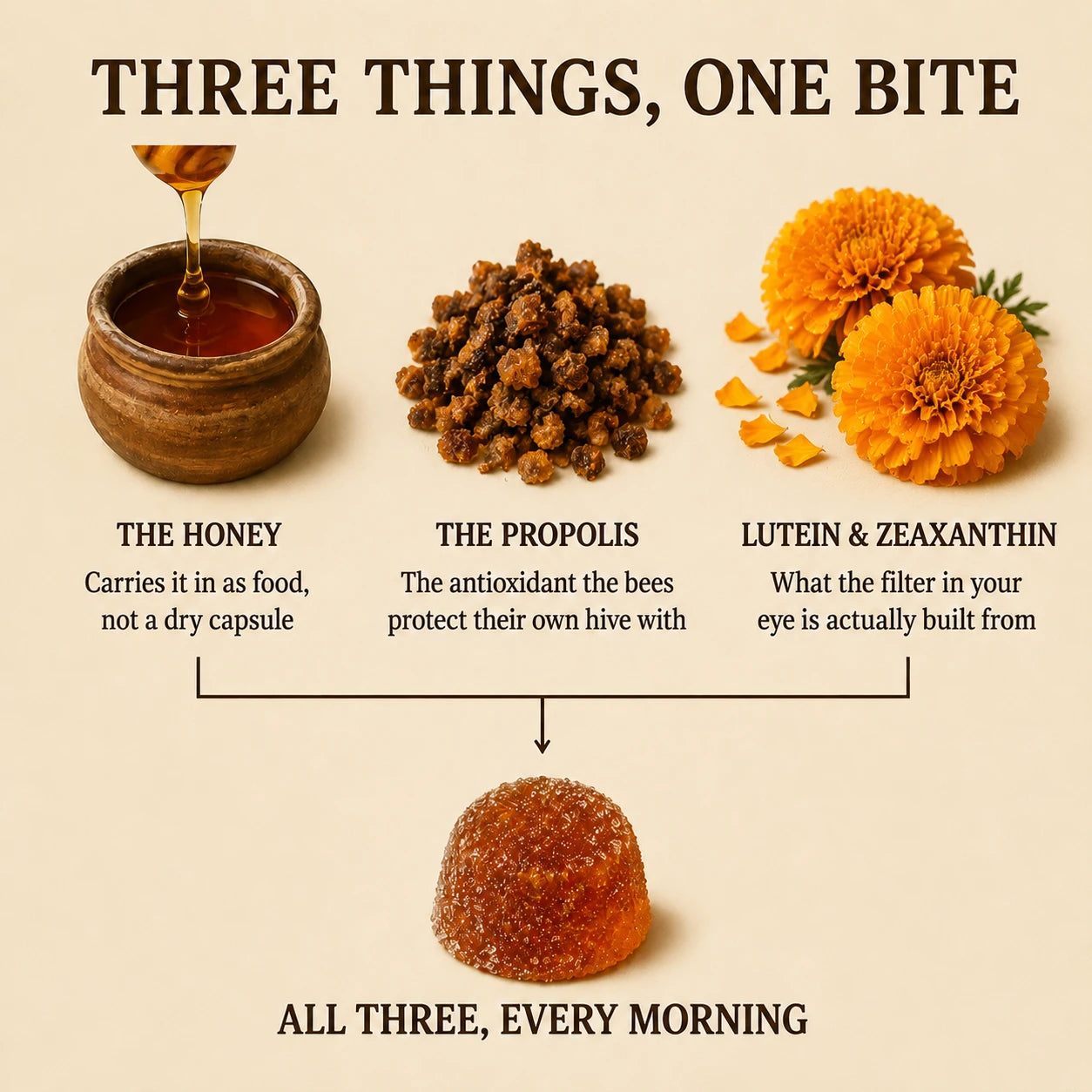
The same bees make propolis, which is the resin they line the hive with to protect everything inside it. When researchers finally tested it, it turned out to be one of the strongest natural antioxidants anybody has measured, and it comes off the same hollow-log colonies those families have kept all along.
Which brings me to the part that has stayed with me longest.
Those families were right for three thousand years and had no idea why. Nobody in those kitchens knew what propolis was. Nobody had ever heard the word antioxidant. They just knew that this particular honey was the thing you gave to the children and the oldest people at the table, and they kept doing it, generation after generation, for longer than most countries have existed.
Then somebody finally put it under a microscope and found out they had been right all along.
So the cheap bottle in the aisle is not the budget version of this. It is the one that gets left in the drawer by the second sleepover. And a jar of ordinary supermarket honey, however lovely on toast, was never carrying the two things the filter is built from.
An ancient hive full of antioxidants. A golden filter in the eye that has to be fed from outside. For three thousand years those two facts never once met in the same spoon.
What Her Daughter Put on the Counter
Here is the part I like.
Coralie did not buy them because of me. I told her what I have just told you, and I sent her home to think about it.
It was her daughter who found the honey gummies, read the same three studies a nurse's worth of skeptical, and quietly put a pouch on the kitchen counter next to the coffee.
What she found came from a small US brand called Lirosia. Real Jimerito honey, the little angel's honey, still rich in propolis from the same hives. And folded into it, the exact two nutrients the golden filter is made of, the pair the body cannot produce on its own. Put into the one format a proud, stubborn grandmother would actually keep taking: two small amber-brown gummies that taste like what they are made with.

Left where she would find it on her own. No conversation, no fuss, just two gummies and a twelve-week ask written on a sticky note.
Her daughter did not make a speech about it. She left the pouch by the coffee with a sticky note.
"Two with your coffee. They taste like honey. Try them for me. Twelve weeks. If nothing changes, throw them out."
Which is exactly why it got past a woman who had refused every version of this conversation for a year. Nothing about it asks her to admit a thing. No drops. No weekly organizer with the days printed on it like a report card. Two amber-brown gummies beside the coffee, tasting of honey.
And because a nurse who read all forty years of the research deserves the fine print out loud: it is made in a GMP-certified facility and third-party tested, so what the label says is what is in the gummy. The honey story is what got her mother to try it. The testing is why her daughter could trust it.
What I tell them to expect, and when
Nothing happens by Friday, and I tell every grandparent in this chair the same thing. A filter that thinned across twenty years comes back across months. It shows up in the small stuff first, and usually somebody else notices before you do.
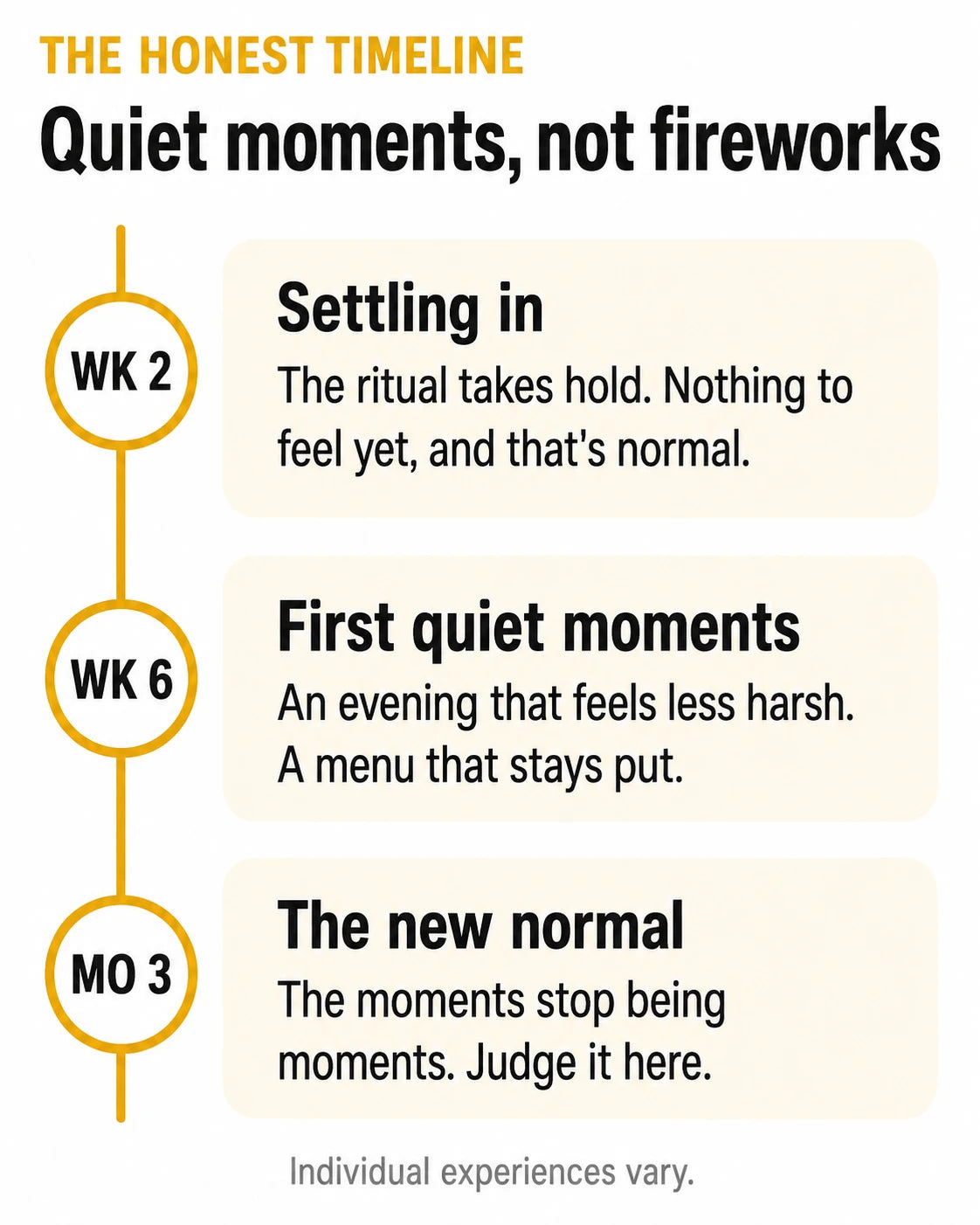
Coralie, who had run out of things to try, tried one more. Junie had two more sleepovers before anything changed at all.
The Twelve Weeks She Wrote Down
I asked her, when she came back, how she knew it was working and not just a good week.
She reached into her bag and put a small notebook on the counter. Her daughter had asked her to write one line a day. So she had. Here it is, in her words, the parts that matter.
 BeforeAfter
Coralie, 69. Same kitchen table, three months apart. Individual experiences vary.
Took the two gummies with the coffee. They taste like honey, not medicine. Nothing to report except I remembered to do it, which is more than I can say for the lamps.
Nothing yet. Same as last week.
Nearly put the pouch in the junk drawer with the readers. Told my daughter. She said give it the twelve. Most people quit right here. This is the week the whole thing is designed to survive.
Junie brought home a drawing. Before she could tell me what it was, I said, "Is that our dog on the beach?"
It was. She yelled "you SAW it" and hugged my arm. I had to go into the kitchen for a minute so she would not see my face.
Drove myself home from book club in the dark. Did not think about it until I was in the driveway.
My daughter called and I told her, and there was a pause, and she said, "You didn't ask me to drive you." I said no. I didn't.
Theo's winter concert. Found him in the second row before he found me. Waved. He waved back with the whole arm, the way he does.
Nobody in that gym knew what that was except me.
 BeforeAfter
The floor and the game. Same living room, same rug, ten weeks apart. Individual experiences vary.
Sunday game on the rug. Played all four rounds. Nobody said "rest your eyes," because I did not have to.
My knees gave out before my eyes did, and that felt like the best complaint I have had in years.
Read Junie the whole bedtime book. All of it. Every page, under the same lamp.
At the end she looked up and said, "Grandma, you didn't skip any pages this time."

"She'd been noticing the skipped pages all along," Coralie says. "A six-year-old was the one who told me they'd stopped."
She closed the notebook there. She did not need to read me the rest.
That is the line I think about. A six-year-old had noticed, all along, every page her grandmother skipped. And a six-year-old was the one who told her they had stopped.
Coralie did not get her eyes fixed. Nothing was broken. The filter just had something to rebuild from again.
She got her place back.
That was a few months ago. She has had two gummies with her coffee every morning since, including this one. And here is the line she keeps coming back to.
"I thought I was quietly turning into the grandmother they had to work around. Turns out I was just a grandmother who ran out of something. I am still me. I just had to feed her back."
If your eyes have been quietly taking these from you, the stories, the floor, the faces, the keys, one small surrender at a time, that is not an age problem and it is not a lamp problem. It's a supply problem.
Of everything on that list, the supply is the part that is still in your hands.
The Other Grandparents in My Chair
 BeforeAfter
Glenn R., 76. The same bleacher at his grandson's field. Individual experiences vary.

"I'd already handed my son the car keys for good. Told myself it was the parking. It was the dusk. About two months in I asked for them back for one evening and drove myself to my grandson's ballgame, ten minutes each way. Sat in the bleachers and found him at shortstop without anybody pointing. I cannot tell you what those ten minutes gave back. My son says I've got a swagger about me again. I earned it."

"Mine was never dramatic so I almost didnt bother. Just the recipe cards getting further away and the lamp getting brighter and brighter. Now I read my granddaughter a whole chapter without stopping. She told her mother, 'Abuela reads the voices now.' Small thing. It wasnt small to me."

"Thought a honey gummy was a gimmick and I've got a drawer of eye bottles that says I would know one. Nine months in now. They live by the kettle next to the coffee. My daughter says I've stopped holding everything out at arms length, and Im back down on the floor with the little one."
Individual experiences vary.
Notice how small all three of those are. That is the shape it takes when it goes well. Nobody is handed a miracle. They are handed back an ordinary afternoon with the grandkids, one quiet thing at a time, and more often than not the person who says it out loud first is a child.
Picture Next Friday
I have fitted glasses for twenty-four years, and I will keep fitting them, because sometimes a stronger lens is exactly what someone needs.
But a lens has never once put a grandparent back on the living-room floor.
If you have been sitting things out, the games, the stories, the drives, telling everyone it is the weather or the lighting or just your age, it is worth knowing that the part nobody measures might be the part that is actually running low. And that it is fed, or it is not, one quiet morning at a time.
So picture next Friday.
Junie in your lap, the book open, the lamp on. And you read her the whole thing, every page, right to the end.
She looks up when you finish, waiting for you to skip the part you always skip. And you do not skip it. You are back on the floor, back in the story, back in it.
Here is the last thing I will say, and then I will leave you alone about it.
You know roughly how many of these years you get. Junie is six for one more year. Theo is eight for one more year. That number doesn't change today, whatever you decide. What changes is how much of it you spend in the chair, and how much of it you spend down on the floor where they are.
And I'll say the last bit the way I say it across the counter. Taking a few months to think it over is not the same as leaving things where they are. Those months come off the same count. Junie will be seven by the end of them, and she is only six once.
Coralie lost the better part of a year to it before anybody told her what it was. She'll say that's a year she'd like back.
— Nora Bissett, optician

Optimal Vision Gummies
Real honey from a bee with no sting, carrying the two nutrients your body can't make.
- Lutein and zeaxanthin, the two nutrients the eye's golden filter is made of
- Real Jimerito honey, rich in propolis from the same hive
- Two amber-brown gummies with your morning coffee. That's the whole ritual.
- GMP-certified and third-party tested
References
- National Eye Institute (NIH): dietary lutein and zeaxanthin and the protective pigment at the center of the eye.
- Bone RA, Landrum JT, et al. Vision Research, 1985;25:1531-1535. Identification of the two dietary pigments at the center of the human eye.
- Hammond BR, et al. Investigative Ophthalmology & Visual Science, 2014. Randomised, double-blind, placebo-controlled, 1-year trial, 115 participants; pigment density, chromatic contrast and photostress recovery.
- Richer S, Novil S, Gullett T, et al. "Night Vision and Carotenoids (NVC)." Nutrients, 2021;13(9). Randomised placebo-controlled 6-month trial in older adults (mean age 62.7, n=33); glare recovery time and contrast sensitivity under glare.
- Systematic review and meta-analysis of lutein/zeaxanthin intake and pigment density, Advances in Nutrition, 2021 (46 studies, 3,189 participants).
- Centers for Disease Control and Prevention: vegetable intake among US adults (roughly 1 in 10 meets recommendations).
- AAA Foundation for Traffic Safety: glare, night-driving discomfort, and driving self-restriction among older adults.
- Published composition research on stingless-bee ("miel de angelita") honey: antioxidant and nutraceutical properties compared with ordinary honey.