The Small Print Keeps Getting Blurrier. It Isn't Your Age. And the 3,000-Year-Old Habit the Health Industry Never Copied.
There's a bee in Central America the size of a grain of rice, and it has no sting. A whole colony makes about one jar of honey a year, so the families who keep them never sold it. They kept it at home for the children and the oldest people at the table. When researchers finally tested what's in that hive, it turned out those families had been right for three thousand years.
The old way of keeping these bees is now formally protected, because it's dying out. Here is the story, what those families were doing right without knowing why, and the two things the filter at the centre of your eye is actually built from.

All references are stated in the footer.

Estela Marroquin, 71, in her own kitchen in Phoenix. Thirty-five years teaching third grade. She still cooks from her mother's hand-written cards, and last year the cards started drifting.
Estela Marroquin stood at her kitchen counter on a Sunday afternoon holding a recipe card at the full length of her arm.
Her mother's handwriting. The long one, the mole, written in Merida in a looping Yucatecan cursive nobody teaches anymore.
She moved it further out. Then she carried it to the lamp. Then she carried it to the window.
Then she set it face down on the counter and made the dish from memory, because she could not read the line about the chocolate.
It came out wrong. Not ruined. Wrong.
Her daughter ate two plates of it and said nothing at all, and the nothing was the worst part of the afternoon.
"I taught six-year-olds to read," Estela says. "For thirty-five years. And I stood in my own kitchen and guessed at my mother's hand."
"I want to be careful how I say it, because it sounds like a small thing and it was not a small thing.
I was never a woman who could not read a card. I was the woman other people's children were sent to when they could not read.
And there I was putting my mother's writing face down on my own counter because it was easier than admitting I could not follow it. That was the afternoon I stopped being the teacher in this house."
She told me that story at her kitchen table in Phoenix, and then she laughed at what was sitting on it.
But we will get to that.
Because first there is the honest part, the part nobody writes down, which is everything the last two years had already quietly taken out of her week.
The Things She Stopped Doing First

Nobody mentions this at an eye appointment, because it does not present as an eye problem. It presents as a woman who has quietly started cooking from memory.
She would tell you she has given up nothing. She would mean it.
Then you watch a week of her life and you count the small rearrangements.
The lamps came first. One for the corner, then one for the counter, then one beside the good chair, and brighter bulbs for all three, and the kitchen light burning at noon in Phoenix in July.
The morning crossword stopped about a year ago. She told her daughter she had gone off them, which was not true.
She started coming in from the garden earlier in the evening. She planted that garden herself, every bit of it, and now she sits out in it for less time than she used to.
Sunday afternoons at her daughter's house began ending before sunset. She calls that beating the traffic. By December it meant leaving at half past four.
The bedtime book started going to Lucia, who is eight years old. "You read it tonight, mija." Lucia loves being asked. She has no idea why she's being asked.
And the recipe box has sat in the same spot on that counter since 1994, but she stopped taking the cards out of it. She cooks around them now, from memory.
Not one of those things is a symptom. All of them are a woman quietly rearranging her house so that nobody ever has to be told anything.
So here is the honest version of the list. These aren't symptoms. These are the five things it had already taken from her, in the order that matters.

Nobody says the number out loud. Most people her age have worked it out anyway.
If three or more of those sounded familiar, you're not imagining yours either.
Estela had all five, and had had all five for about two years, and had never once said a word about any of it out loud, including to the woman who checks her eyes.
What she did not know was that every line on that list was still recoverable, and that she would get them back in an order she would never have predicted.
First, though, she spent two years buying the wrong things. Carefully, and with receipts.
What She Bought Before She Asked Anybody

Two years, six line items, six hundred and sixty-five dollars. Six sensible purchases, every one of them aimed at the wrong thing.
None of it was a foolish thing to buy, and I would have bought most of it myself. Estela taught on a teacher's salary and raised two children on it, so she knows exactly what everything in her house cost. When her daughter finally asked what she had already tried, she did not have to think about it. She went and got the receipts.
She totalled the column the way she used to total a field-trip envelope. About $665 over two years, and not one of them gave her back a single card.
The magnifying lamp is the one she wants to be fair about, and the only thing on that list she still owns. It genuinely helped with the recipe cards. It also lives on one table in one room, and her mother's handwriting is not the only thing in that house she needs to read. It was enough to make her keep it. It was never enough to fix anything.
That is the point where most people decide the whole category is a con.
It is not the money. A retired teacher can absorb $665 over two years. It is that six failures in a row stop feeling like six bad products and start feeling like a verdict about you.
And one of them took something worse than the money
You have seen the ads. A specialist nobody can find in any directory, a miracle story, a countdown timer running in the corner. The review pages of that corner of the category tell you exactly how those stories end. When the trust breaks, people stop taking anything at all. The scam doesn't just take your money. It takes your willingness to try.
The Last Reader
Here is the arithmetic that was actually sitting on that counter, and it has nothing to do with dollars.
Estela's mother wrote those cards in Merida in the nineteen forties, in the cursive they taught in Mexican schools then. Loops, ligatures, a lowercase r that does not look like anybody's r.
Marisol, her daughter, cannot read it. She has tried. She gets about four words in.
Lucia, who is eight, cannot read cursive at all. Almost no eight-year-old in America can anymore.
So there is exactly one person left alive who can read the box on that counter.
And she was quietly losing the ability to do it.
Read that again, because it's the whole thing in one sentence. When Estela can't read those cards anymore, nobody can. Her mother's handwriting leaves the family with her.

She told her daughter that evening she thought she had a cold coming.
She worked that out on her own, standing at the counter with the box open in front of her, and it took her legs out from under her. She sat down on the kitchen floor. Not gently, and not for a second or two. She sat on the tile with her back against the cupboard door and cried until her chest ached and her face was a mess, and when Marisol phoned that evening she said she thought she had a cold coming.
Thirty-five years she spent teaching other people's children to read. She was not about to say out loud that she was losing her own mother's handwriting.
And nothing dramatic was happening to her. That's the problem with the way this arrives. It shows up as a lamp, and then another lamp, and then a card you quietly stop taking out of the box, and at no point does it announce itself as the thing that ends with you.
Nearly every family has a version of that box. A photo album with the names written on the back. A bible with the family in the front of it. A bundle of letters somebody carried across a border. Whatever it is in your house, one person is the last one who can still read it.
And here's the part worth stopping on, whatever's in your house.
Estela has already spent two years on this. Not two years of being unable to see. Two years of cooking the long recipe from memory, turning the card face down, and handing the bedtime book to an eight-year-old. She got those two years. She just did not get to use them for the things she would have chosen.
That is the actual price of it, and it never showed up on a receipt.
Now think about why nobody ever told her any of this.
Nobody stocking that shelf is lying to you. It's simpler than that, and honestly it's worse.
There is nobody whose job it is to tell you. Not one person in the whole chain. Your eye doctor is paid to measure how well you see today and sell you the lens that fixes today. The pharmacy is paid when you come back for another bottle. The company that makes the bottle is paid the same whether it works or not. Follow the money all the way down and you will not find a single person who earns anything by telling you what actually ran out.
So nobody says it. Not out of malice. Out of arithmetic.
So Estela took the question to the one person on her street who had never once tried to sell her anything.
And he refused to ring it up.
Then Teo Put the Bottle Back on the Shelf

The conversation nobody in that building gets paid to have, happening anyway, at a counter on the corner of her street.
His name is Teo Vargas and he has been behind the counter at the pharmacy on the corner of her street for twenty-two years. He filled her husband's prescriptions. He knows what she takes and what she does not.
She brought him the third bottle of eye vitamins and asked him the only question she knew how to ask. Is this one any better than the last one.
He turned the bottle over and read the back of it for a lot longer than she expected. Then he put it down on the counter and didn't ring it up, which in twenty-two years she had never once seen him do.
He looked over her shoulder to check there was nobody else in the shop.
"I'm going to tell you something I probably shouldn't, standing here in front of a shelf I'm supposed to be selling from."
She told him to go ahead.
"There's nothing wrong with your eyes wearing out. That's not what's happening."
He let that sit.
"Something in there stopped getting refilled. And it's been stopping for about twenty years."
She made him say it twice.
Then she asked the obvious thing. Two years of lamps and bottles and a prescription. Why had nobody ever mentioned this?
He told her the truth, which is that it does not come up because nobody in the building gets paid for the conversation.
The problem with her eyes was never that they were old. It was that the one thing they run on has to arrive from outside, and it had stopped arriving.
She drove home and did what a teacher does. She looked up exactly what had stopped arriving.
The Pantry Nobody Told Her About

The layer, fed versus running low. When it is stocked, light lands clean. When it thins, light starts to scatter, and scatter is what you experience as glare, haze and fading contrast.
There's a small patch at the back of your eye, right in the middle, where your sharpest vision happens. It's covered by a thin golden filter.
The easiest way to picture it is a pair of built-in sunglasses, worn on the inside, sitting exactly where you need to see best. It soaks up the harshest light before that light can wear on the delicate middle of the eye, and it's what keeps writing sharp and edges clear.
That filter is built out of two nutrients. They're called lutein and zeaxanthin, and they are the only things it's made of.
Now here is the part that changes how the last two years read.
Your body cannot make either one of them. Not a bit. Not at fifty, not at seventy, not in any amount, ever.
Every scrap of that filter arrived through food. Mostly dark leafy greens, the spinach and kale and collards that most of us eat less and less of as the years go by.
When the filter gets thin, light scatters around inside the eye instead of landing where it should. That scattering is the glare on the drive home. It's also the haze on the recipe card.
And this is where nearly everybody gets it wrong, so let me be clear about it.
Estela is not underfed. She eats three good meals a day and she cooks every one of them from scratch. The problem was never how much food went on her plate. It's that almost nothing on a normal plate carries these two, and the CDC says only about one in ten of us eats the vegetables we're supposed to.

Fifty years of cooking, and she had never once solved an empty shelf by buying a nicer pan.
She understood it completely the moment she put it in her own language, which after fifty years of cooking is the language of a kitchen.
You can buy a better stove. You can hang a brighter light over the counter. You can buy the good knives.
If there is nothing in the pantry, you still cannot make the dish.
Brighter bulbs are a brighter light over the counter. A stronger prescription is a better stove. Neither one of them puts a single thing in the pantry.
Fifty years of cooking, and she had never once solved an empty shelf by buying a nicer pan.
Not the lamps. Not the glasses. Not her age.
The pantry.
Go back down that receipt column with the pantry in mind, and every line explains itself. The lamps and the brighter bulbs were a brighter light over the counter. The readers and the prescription pair were a better stove, beautifully accurate and pointed at an eye whose own layer was thinning out underneath it. The capsules had the right idea in them, but she took them for eleven days, then nine, then thirteen, and six weeks of spinach was one good month held up against twenty years of an empty shelf.
Six sensible purchases by a careful woman, and not one of them was ever pointed at the shelf that was actually empty. Which is why none of it was her fault, and why six failures in a row were never evidence about her.
And the general multivitamin sells a pinch, not a shelf
Turn over one of those hundred-ingredient one-a-days. The two your eyes actually run on are either absent or in there as a pinch. It is assembled to fill out a label, not a pantry. That is why the drawer of abandoned bottles changed nothing even in the months she finished the bottle.
Which leaves the only question worth anything. What actually refills the pantry, and how do you get it in there every single day without having to think about it?
What She Found When She Went Looking
Estela is a teacher, so she did not take Teo's word for it. She went and read.
The National Eye Institute is unambiguous that the pigment at the center of the eye comes from what you eat, and that lutein and zeaxanthin are what it is made of.
The CDC is the source of the number that keeps coming back, the one in ten.
And then she found the thing she could not get past.
None of this is hidden. Two researchers worked out what that filter is made of in 1985. That is forty years ago. It is written on a government website that anybody can read this afternoon, for free, in plain English.
And in two years of lamps and bottles and one full eye exam, nobody had ever said a word of it to her.
It isn't a secret anybody is keeping. It's a secret because there is nobody whose job it is to say it out loud.
There is no clever name for any of this, and I want to be straight with you about that.
The families who have been doing it for three thousand years never had a name for it. The researchers who eventually worked out why it works have never had a reason to give it one either. So I am going to call it the golden layer method, because that is literally what it is. You feed the golden layer. There is nothing else to it and nobody is selling you a system.
So now she knew what had to go back in. What she did not know is that putting it back is where nearly everybody trips, and there are two ways to trip.
The first is that these two nutrients don't travel on their own. They only get absorbed properly when they arrive with some fat and some food around them. Swallow a dry capsule on an empty stomach and a good part of what you paid for goes straight through you.
The second is that you have to still be taking it in three months' time. That's where it usually falls apart. Everybody starts. Almost nobody is still going in March.
Which is where a three-thousand-year-old habit turns out to have solved both problems long before anybody understood why.
The Bee That Cannot Sting

Small enough to sit on your fingertip, and it has no stinger. The families who keep it do not call it an insect. They call it la angelita. The little angel.
Deep in the forests of Central America lives a bee so small it could rest on the tip of your finger, and it has no sting at all.
The Maya believed the honey it makes was a gift from the gods. They named their sacred bee the Royal Lady. They had a god of the bees, and beekeepers who passed hives down the way other families pass down land.
That was three thousand years ago, and here's the remarkable part. Those families never stopped.
To this day, in the Yucatan and Honduras, you can find the little hives tucked beside kitchen doors, tended by grandmothers who were taught by their grandmothers. The honey inside is saved for the people they love most: the children, the elders, and the parts of the body they most wanted to protect. That included, in their tradition, the eyes.
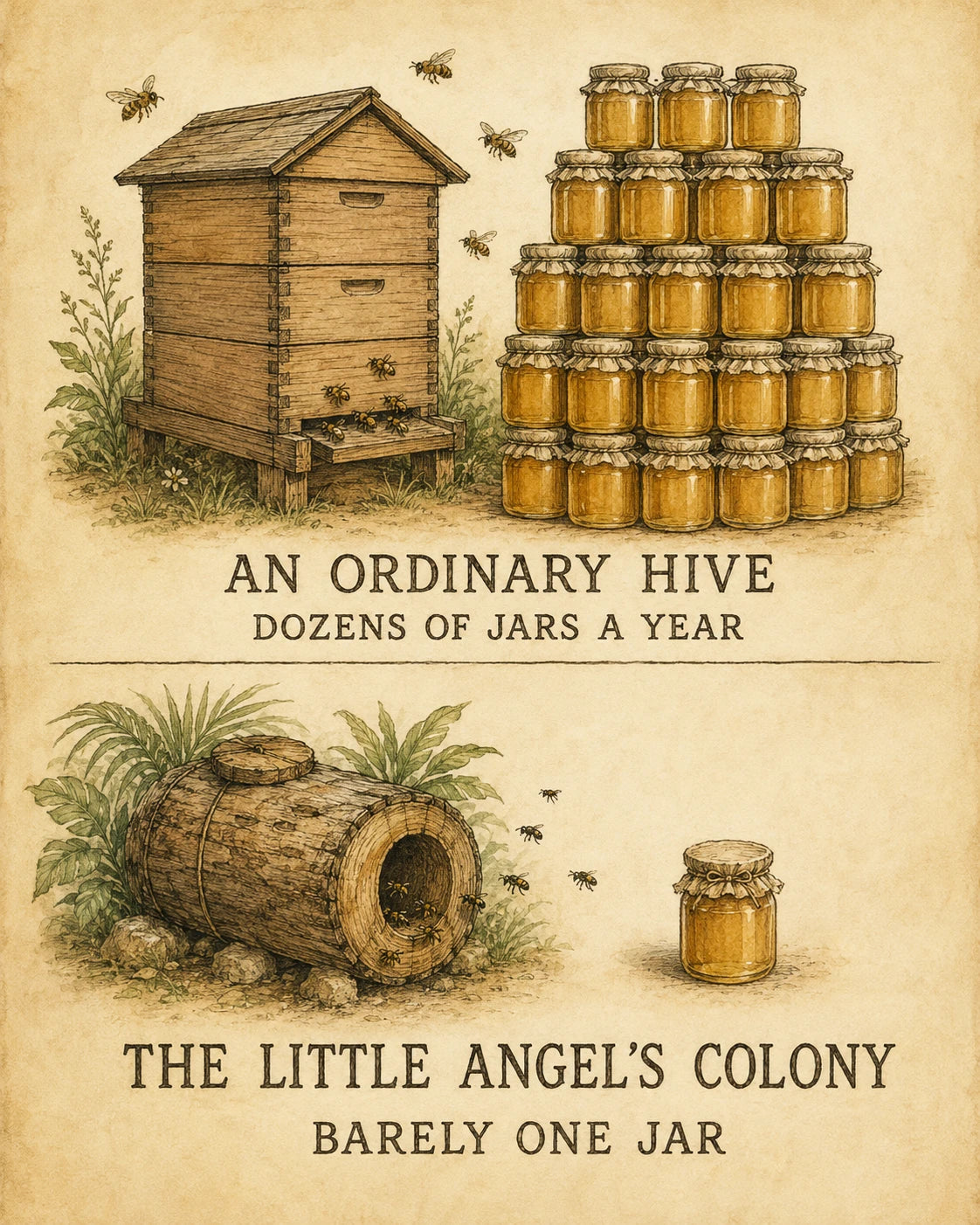
Here is the thing about this bee. A whole colony, working for a whole year, makes about one small jar. An ordinary beehive gives you dozens of kilos in the same time.
You cannot speed it up and you cannot do it at scale, however much money you throw at it. That is why, for most of three thousand years, this honey was never really sold. Families kept it on a high shelf at home and handed it out a spoonful at a time.

Estela, around six, waiting for her spoonful. "You didn't ask twice," she says. "You waited, and it was worth waiting for."
Estela knows exactly what that spoonful tastes like.
She grew up in Merida, in a house where a clay pot of angelita honey lived on the top shelf of the kitchen. Out of reach. That was the point.
"On special mornings my grandmother would take the pot down and give each of us one small spoonful. Not two. One.
She said the little bees had worked a whole year for that jar. So you took your spoonful slowly, and you said thank you.
I'm 71 years old and I can still taste it. A little bit of citrus, a little bit of flowers. Nothing I have ever bought in a store has tasted like it."
And here is the part that stays with you once you have heard it.
Those families were right for three thousand years and had no idea why. Nobody in that kitchen in 1961 knew what propolis was. Estela's grandmother had never heard the word antioxidant and never would. She just knew that this particular honey was the thing you gave to the children and to the oldest people at the table, and she kept doing it, the way her own grandmother had, for longer than most countries have existed.
Then somebody finally put it under a microscope.

Research on stingless-bee honey has found higher antioxidant content than ordinary honey. The old rationing starts to look less like superstition and more like an instinct science hadn't caught up to yet.
Stingless-bee honey turned out to be a different substance from the honey on supermarket shelves. Studies have found it carries more antioxidants than ordinary honey, along with a distinct profile researchers are still mapping.
And the honey is only half of what the hive makes.


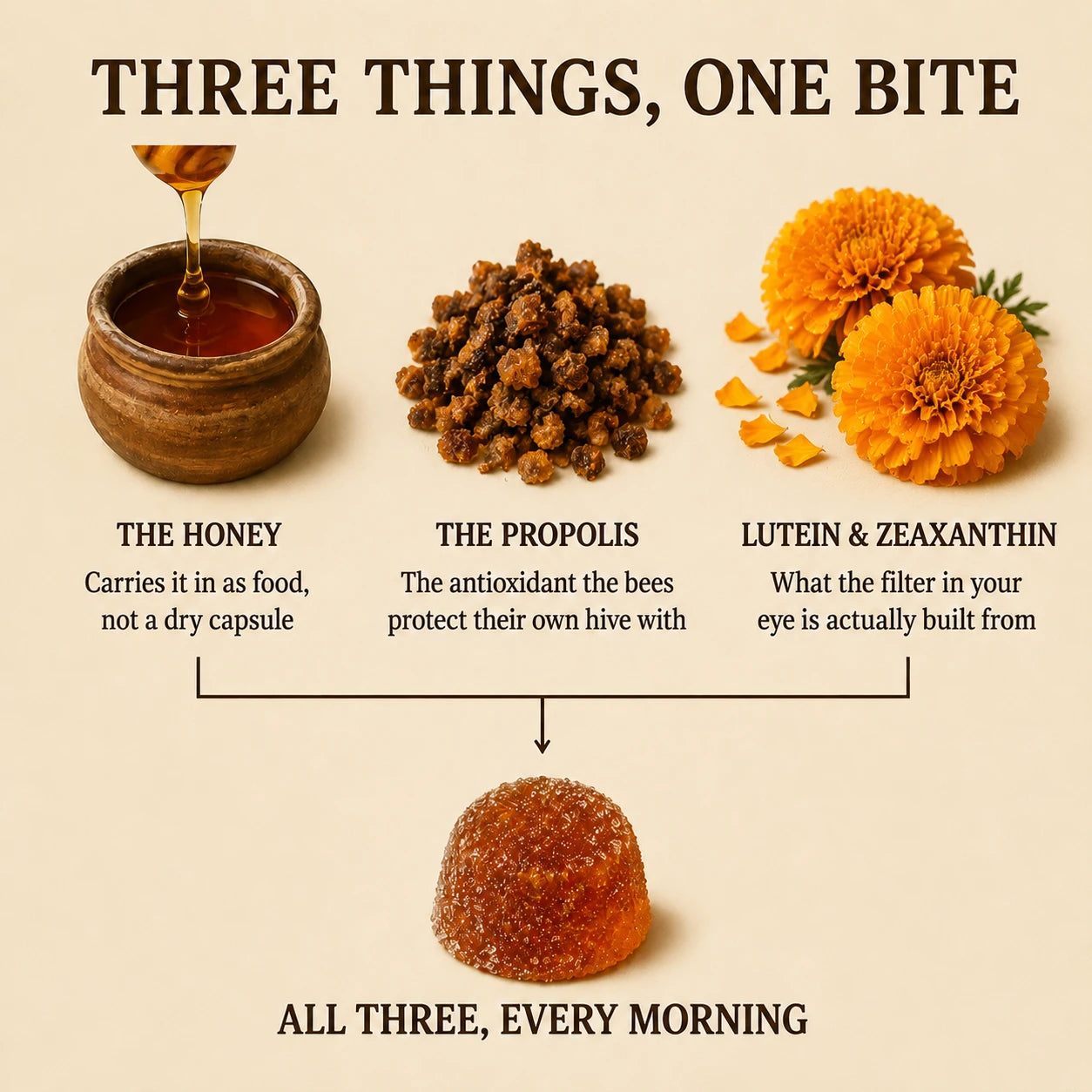
The two things the hive makes: the honey the families rationed, and propolis, the substance the bees use to protect everything they've built.
The same little bees produce propolis, a resin-like substance they line the hive with to guard it. It is one of the richest natural sources of antioxidants known, and it comes from the exact same colonies the families have tended all along.
Why the honey on its own wouldn't have fixed anything
This is the part worth being straight about, because a jar of that honey sitting on Estela's counter would have changed nothing.
The honey on its own is a lovely thing to eat, and it does not put back what her eyes had run out of. It's the carrier. It's what turns this into food your body absorbs instead of a dry capsule you forget to take.
The propolis is the antioxidant, the substance the bees use to protect their own hive from damage.
And the two nutrients are the ones that filter in your eye is actually built from. Those are the ones your body can't make.
You need all three arriving together, in the same bite, every morning. That is what finally gives the eye something to rebuild with, and it is exactly the combination those families were spooning out without ever knowing what was in it.
Which is why the nine-dollar bottle in the aisle is not the cheap version of this. It is the bottle that gets abandoned at the back of a cupboard. And a jar of ordinary supermarket honey, however lovely on toast, was never carrying the two things the layer is built from.
An ancient hive full of antioxidants. A golden layer in the eye that has to be fed from outside. For three thousand years those two facts never met.
Why I Chased This Story

Miel de angelita. Little-angel honey, photographed beside the kind of hollowed log the families still keep the colonies in.
I will be honest about why I went digging. An ancient honey and a modern eye nutrient landing in the same sentence sounded like marketing, and I expected to find an invented legend.
What I found instead was paperwork. Beekeeping records going back centuries. Researchers publishing the honey's composition under its real name, miel de angelita. And an international food-heritage organization formally protecting the Yucatan's stingless-bee tradition, because the old way of keeping the little angel is endangered and people are fighting to save it.
Nobody builds a conservation program around a marketing story.

"They saved it for their children and their elders," one conservation researcher notes of the tradition. It was never a product. It was an act of care, passed down.
Which brings us back to Teo, and to the last thing he said before Estela left the counter that afternoon.
"Whatever you end up buying, buy the one you'll still be taking in March. Give it three months before you decide anything. What's it cost you to find out?"
How the Old Ritual Became a Morning Gummy
This is where Estela's kitchen table comes back in.
A small US brand called Lirosia did the one thing the old healers never could. They took real Jimerito honey, the little angel's honey, still rich in propolis from the same hives. And they folded in the two nutrients modern science says the golden layer is actually made of: lutein and zeaxanthin, the pair your body cannot make on its own.
Then they put it in the one format the old families would have recognized: something you would actually look forward to taking.
Estela did not find it because of the science. She found it because she read the label and said her grandmother's word out loud in the middle of her own kitchen.
"Angelita. I said it like an idiot, to nobody. And then I sat down."

Amber-brown, semi-translucent, like dark honey. The color comes from what's in it.
Two small amber-brown gummies, with your morning coffee. They taste like what they are made with. That is the whole ritual.
Not a horse-pill. Nothing to choke down or dread. A careful spoonful, updated by seventy years of nutrition science.
And because the reader who was burned before deserves the fine print out loud: it is made in a GMP-certified facility and third-party tested, so what the label says is what is in the gummy. The honey story gets people to try it. The testing is why they can trust it.
How long three thousand years takes to show up
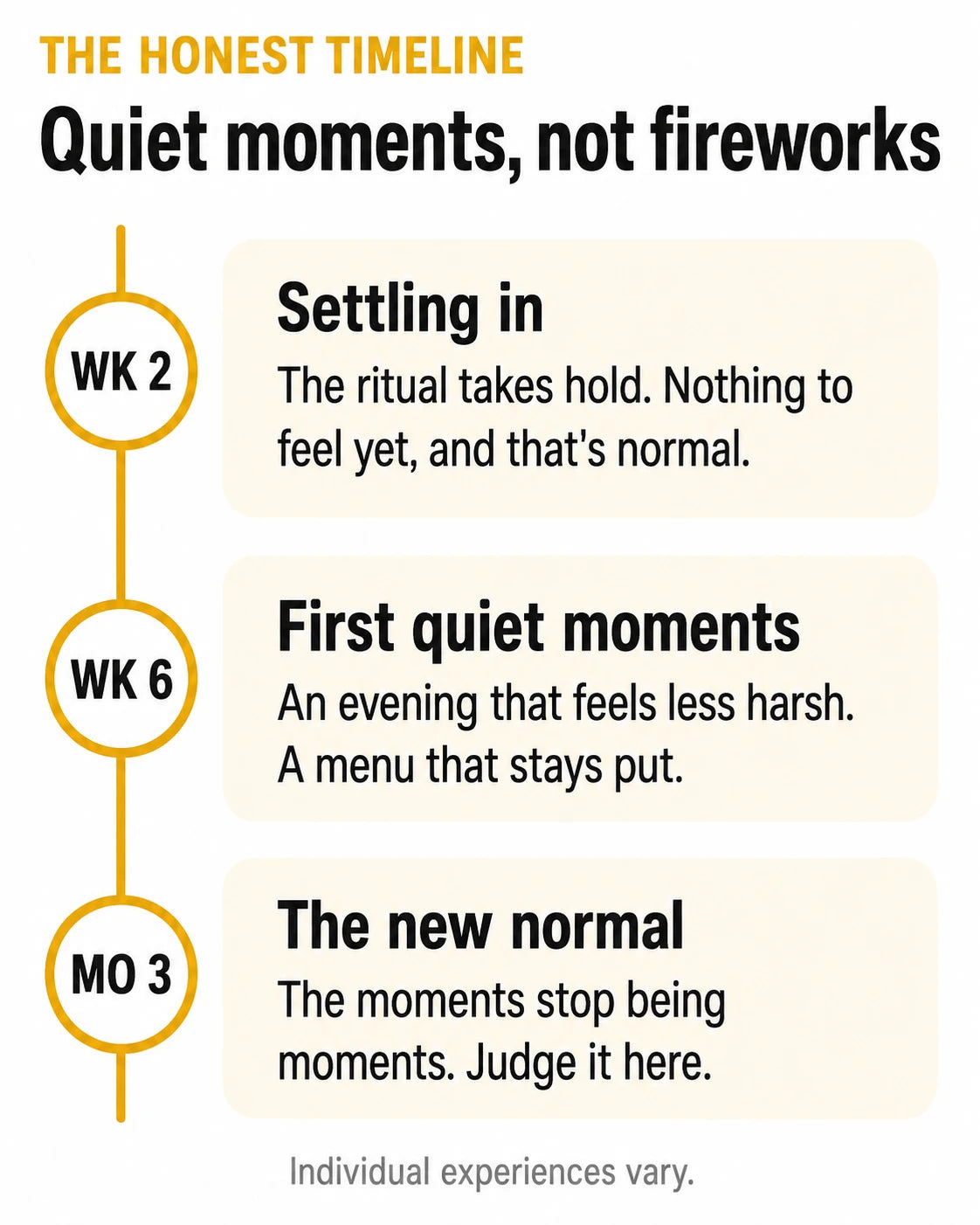
Three thousand years of patience is the right frame here too. Nothing happens overnight, and anyone who promises otherwise is selling you something. A pantry that emptied across twenty years gets restocked across months. What comes back arrives the way it left, one small thing at a time.
Estela's reasoning was not complicated. She had already itemised $665 that did nothing. What was one more line?
So she started. The first three squares of the calendar stayed empty.
What Happened Over the Next Twelve Weeks
 BeforeAfter
Estela Marroquin, 71. Same counter, same card, twelve weeks apart. Individual experiences vary.
She did not buy a notebook. She wrote one word a week in the squares on the free calendar the pharmacy hands out at Christmas, the one with the saints on it, hanging on a nail by the fridge.
Two gummies with the coffee. In the square she wrote one word: Miel. Honey. Because that is all it was so far, and she is not a woman who writes things down before they are true.
The square says Nada.
She nearly stopped here. Most people do.

Week 5. The first morning in about a year that she picked the pen up.
She did the crossword on a Tuesday morning, for no particular reason, the way she used to. She finished it before her coffee was cold.
She sat there for a minute afterwards holding the pen, because it had been about a year since she had done one, and she had told everybody she'd simply gone off them.

Week 7. She came in because it got cold, not because she could not see.
She stayed out in the garden until the light had properly gone, cutting back the sage, and only came in because it got cold.
The four-pack of the brightest bulbs the hardware store sells is still sitting in her garage, unopened.
She stayed at her daughter's for dinner on a Sunday in November and drove home afterwards in the dark, which she had not done since the spring. She did not announce it. She simply stopped leaving at half past four.
Marisol was the one who said something, on the phone the next morning, and she said it carefully, the way you do when you are not sure you are allowed to mention a thing.
"Mama, you drove home in the dark. You haven't done that in a year and a half. I sat in the window until your headlights went round the corner and I didn't want to say anything in case I jinxed it."
Estela told her not to be dramatic. Then she went and sat down in the kitchen for a while.
 BeforeAfter
Reading to Lucia. Same bedroom, twelve weeks apart. Individual experiences vary.
A Sunday afternoon. She took the long card out of the box, propped it against the sugar tin, and cooked from it standing at the counter in the ordinary kitchen light.
She read her mother's loops. All of them, including the line about the chocolate, and the part at the bottom where her mother had run out of room and written up the side of the card.
It came out the way it is supposed to come out. Marisol had two plates and this time she said so.
And that Saturday night, when Lucia held the book out and waited, Estela took it and read it herself.
Four pages in, Lucia looked up and said, "Abuela, you did the voices again."
She hadn't done the voices in about two years. All her effort had been going into getting the words off the page at all, and there was nothing left over for the voices.
That was five months ago. She has had two gummies with her coffee every morning since, including this morning.
Twelve weeks, and she had them all back. Not one square on that calendar says anything dramatic. A woman just started cooking from her mother's cards again, and doing the crossword, and staying out in her own garden after the light goes.
If your eyes have been quietly taking the small print, the drive home, the labels you wrote yourself and the book you used to be the one to read, that is not an age problem and it is not a lamp problem. It's a pantry problem.
And the pantry is the one thing on that whole list you can actually restock.
"I Bought It for the Story. I Stayed for What Happened."
 BeforeAfter
Miguel S., 69. His own garage. Individual experiences vary.

"A nice story is not a result, and I said that out loud when I ordered. My wife is Guatemalan and her grandmother kept stingless bees behind the house, so I bought it for her more than for me. Somewhere in the second month I caught myself reading the church bulletin without holding it out at the pew, and I just sat there a second. My wife leaned over and said 'you're reading that.' I said 'I know.' Neither of us wanted to say anything else in case we jinxed it."

"I got taken once by one of those brands with the specialist in the ads so I read every label twice now. I checked this one properly and it held up. Real honey, third-party tested, nothing on the panel I had to look up. Been taking them since March and never missed a morning. Around week seven I did my crossword under one lamp instead of three. My sister asked what Id changed."

"It took me about two months and I want to say that for whoever is sitting there at week three wondering. They tell you that upfront, I just didnt quite believe it. Evenings are less scratchy now and Im not chasing brighter bulbs around the house anymore. My husband noticed before I did."
Individual experiences vary.
Notice how small all three of those are. That is what this looks like when it works. Nobody is handed a moment. They are handed back an ordinary week, one lamp at a time, and they usually notice a couple of weeks after it happened.
Picture an Ordinary Morning, a Few Months From Now

"My grandmother would have laughed," Estela says. "All those years the pot lived on the top shelf. Now it's next to my coffee maker."
Coffee is on. You take your two gummies, the way you might once have taken a careful spoonful of something your grandmother swore by.
Later that week there is a birthday card to read, and you read the whole thing out loud, including the handwritten part at the bottom, without holding it away from you.
The lamp in the corner stays off. You drive home after dinner in the dark and nobody says anything about it, and nothing getting said is the whole victory.
And on a Sunday, the box comes down off the counter and you make the long one, from the card, in the ordinary light.
Nobody claps and nobody makes a fuss. That's exactly what makes it good. It's just yours again.
Somewhere in the middle of it your daughter says "you seem lighter lately," and you think about a small bee in a forest a long way from here, and you keep the reason to yourself.
And here is the part worth sitting with for a moment. You know roughly how many good years you have left. Most people past sixty do. You have likely counted it once, on your own, and then never said the number to a soul.
That number doesn't change today. What changes is how much of it you spend cooking from memory, putting the card face down, and handing the book to somebody younger.
And here is the part that gets missed. Waiting a few months to make up your mind is not the same as doing nothing. Those months are taken off the same number. You would be spending the very thing you are weighing up.
Estela spent two of hers working around it. She'll tell you those are two she'd like back.
— Marion Ellis

Optimal Vision Gummies
Real honey from a bee with no sting, carrying the two nutrients your body can't make.
- Real Jimerito honey, from the bee families have guarded for 3,000 years
- Rich in propolis, the substance the hive makes to protect its own
- Lutein and zeaxanthin, the two nutrients the eye's golden layer is made of
- Two amber-brown gummies with your morning coffee. That's the whole ritual.
- GMP-certified and third-party tested
References
- Slow Food Foundation for Biodiversity: the Yucatan Peninsula Xunankab (stingless-bee) honey Presidium and the endangered Maya beekeeping tradition.
- Published composition research on "miel de angelita," the honey of the stingless bee Tetragonisca angustula.
- Peer-reviewed research on stingless-bee honey: antioxidant and nutraceutical properties compared with ordinary honey.
- Historical scholarship on Maya stingless beekeeping (Melipona beecheii, the "Royal Lady" bee) across roughly 3,000 years.
- National Eye Institute (NIH): dietary lutein and zeaxanthin and the protective pigment at the center of the eye.
- Centers for Disease Control and Prevention: vegetable intake among US adults (roughly 1 in 10 meets recommendations).
- Bone RA, Landrum JT, et al. Vision Research, 1985;25:1531-1535. Identification of the two dietary pigments at the center of the human eye.
- Hammond BR, et al. Investigative Ophthalmology & Visual Science, 2014. Randomised, double-blind, placebo-controlled, 1-year trial, 115 participants; pigment density, chromatic contrast and photostress recovery.
- Richer S, Novil S, Gullett T, et al. "Night Vision and Carotenoids (NVC)." Nutrients, 2021;13(9). Randomised placebo-controlled 6-month trial in older adults (mean age 62.7, n=33); glare recovery time and contrast sensitivity under glare.
- Systematic review and meta-analysis of lutein/zeaxanthin intake and pigment density, Advances in Nutrition, 2021 (46 studies, 3,189 participants).
- Published long-term US government eye-nutrition research on lutein and zeaxanthin supplementation.