That Haze in the Morning. The Starbursts Around Headlights. The Face You Can't Quite Place. It Isn't Your Age, and Stronger Glasses Won't Fix It.
These three things arrive in an order, and almost nobody recognises the early ones until they're past them. Here is what each one actually is, why it is not your prescription, and what can still be done while it's early.
There are two nutrients the middle of your eye is built to run on, and your body cannot make either one. Most Americans over 50 are quietly running short of both, and almost none of them have ever been told.

All references are stated in the footer.

Diane Kowalski, 68, at her kitchen table in Grand Rapids. She spent thirty-one years putting the right book in the right hands. Walks two miles a day, does the morning crossword in pen. Not the kind of woman who quietly stops driving at night for no reason. And she is not the only one.
Diane Kowalski can tell you the exact night she stopped pretending.
It was the drive home from her sister Ruth's place across town, a road she has taken a hundred times. Dark, familiar, nothing to it.
Except the oncoming headlights did not look like headlights anymore. They bloomed into starbursts and smeared across the windshield. She caught herself slowing to a crawl, sitting forward, both hands locked on the wheel.
"I started leaving Ruth's before dark," she says. "I told everyone it was about the traffic. It was never about the traffic."
Then there was the morning fog. The second or two of white haze every day before the bedroom swam back into focus.
And the one that finally frightened her, at her church's spring potluck.

She was halfway across the room before she was sure who it was. Somebody she had known thirty years.
"A woman across the hall waved at me, and I smiled and waved back the way you do.
I was halfway across the room before I was sure who she was. Somebody I have known thirty years.
I laughed it off in the moment. Then I sat in the car in the parking lot and I did not laugh. Because it was not the first time. It was just the closest one."
Here is the part that makes this hard.
Diane spent thirty-one years as a school librarian. Knowing the exact book for the exact child was the whole job, and she was famous for it.
That night in the parking lot, she was not thinking about her eyes. She was wondering when she had quietly become a woman who could not read the specials board and had to guess at a friend's face. That is the part nobody warns you about. It does not feel like an eye problem. It feels like losing your grip on your own life.
Most people file each of these moments under "getting older" and move on. Diane did too, for the better part of a year.
What she did not know yet is that these are not random bad days. They tend to arrive in an order. And the order only moves one direction.
The Small Things She Started Rearranging Her Life Around

Diane never mentioned any of this to anyone, because none of it arrived labelled as an eye problem. It arrived as a world that kept needing more light.
Ask Diane straight out and she will tell you she has given up nothing. She means it.
Then you watch a year of her days and you count the small rearrangements.
The lamps came first. A brighter one for the reading chair, then the good bulb for the kitchen, then the kitchen light left burning at noon.
The night driving thinned out. First the interstate after dark, then any drive she could move to daylight, then leaving Ruth's an hour early with a reason always ready in case anyone asked.
Menus started drifting to arm's length, and then out past it, until a dim restaurant meant borrowing the flashlight on her own phone to read the specials.
The crossword she has done in pen every morning for forty years started taking longer, and a small stack of large-print books appeared on the kitchen table, brought home quietly from the library she used to run.
None of that is a symptom. All of it is a sharp woman rearranging her whole week so nobody has to be told a thing.
If you are over 55, some of this list is going to sound familiar.
Three or more of those, and you are not imagining it either.
Most people treat these as seven separate quirks of getting older. A different excuse for each one. But that is not what a librarian's week actually loses. Not seven symptoms. Five things it was quietly taking out of Diane's week, one at a time.
Diane had all five. Had had all five for about a year. And had never once said a word out loud about any of it, including to the person who checks her eyes.
What she did not know yet is that every line on that list was still recoverable, and that she would get them back in an order neither she nor Ruth would ever have predicted.
But first, before she ever asked anybody, Diane had quietly spent a year buying the wrong things. And keeping the receipts to herself.
What a Year of "Fixes" Actually Cost Her

One year, one kitchen drawer, three hundred and thirty-seven dollars. Every one of them a sensible answer to a question that had never been put to her properly.
Read that list without wincing at any of it, because every single item on it was a reasonable thing for a careful person to try. Diane never asked a soul for help. She had been trying to fix it herself for a year, alone, and the proof lived in the drawer by the phone.
She is a librarian. She kept the receipts. When Ruth finally sat her down and asked what she had already tried, Diane laid it out like a card catalog and Ruth added the column up. Three hundred and thirty-seven dollars over one quiet year, and not one of it gave Diane back a single thing on that list.
The magnifying sheet is the one she wants to be fair about. It genuinely helps her read the fine print at that one kitchen table. It also lives on that one table, and her whole life is not on it. It was enough to make her keep it. It was never enough to fix anything.
That is the point where most people decide the whole aisle is a con and stop looking.
It is not the money. A retired librarian can absorb $337 over a year. It is that a drawer of failures in a row stops feeling like a drawer of bad products and starts feeling like a verdict about you. That is when a proud woman quietly stops trying anything at all.
And one corner of the category takes something worse than the money
You have seen the ads. A specialist nobody can find in any directory, a miracle story, a countdown timer ticking in the corner. The review pages of that corner tell you exactly how those stories end. When the trust breaks, a person stops taking anything at all. The scam doesn't just take your money. It takes your willingness to try, right when the window is still open.
The Order Nobody Warns You About

Talk to enough people over 55 about their eyes and the same sequence keeps surfacing. Families just live it, one stage at a time.
Here is the arithmetic that was actually sitting in that drawer, and it has nothing to do with dollars.
First comes the haze in the morning. You wake up and the room looks like you're seeing it through a dirty window, and it takes a while to clear. You put it down to a slow start.
Then the headlights start bursting. Every car coming the other way turns into a starburst that takes a second or two to fade, and you blame it on modern headlights being too bright. There is a reason that excuse feels true. But notice that the person sitting next to you is not wincing.
Then it's faces. Somebody waves at you from across a room and you cannot tell who it is, and you file that one under "senior moment."
And then, for a lot of people, the quiet afternoon nobody talks about, when someone else starts doing the night driving.
One man in a research interview said the quiet part out loud: "You can wear friends out real fast, asking for rides."
The reason to catch it at the fog and not at the keys is not medical. It is that the window where the fix is still small and simple and yours to make narrows a little more every season it goes unnoticed.
Read that line again, slowly.
Miss that window and the fix stops being two gummies with your coffee. It becomes the conversation about the keys.
Nearly every family has a version of the keys. The car. The stairs. The moment a house somebody has loved for forty years turns into a house somebody else worries about. Whatever it is in yours, there is a window before it, and right now, for a great many people reading this, that window is still open.
And here is the part worth stopping on.

She got that year. She just did not get to spend it on anything she would have chosen.
Diane had already spent a year of hers on it. Not a year of being unable to see. A year of reading in ten-minute bursts, waving first across the church hall so nobody would find out, and being home before the headlights started up. She got that year. She just did not get to spend it on anything she would have chosen.
That is what this actually costs, and none of it turns up on a receipt.
Now follow the incentives for a second, because it explains why nobody ever told Diane any of this.
And I want to be careful here, because this isn't a conspiracy and I don't want it to sound like one.
Nobody is hiding this from Diane. There is just nobody whose job it is to tell her. The doctor is paid to check the eye for disease and write a prescription. The shop is paid when she buys the lenses. The pharmacy is paid when she comes back for another bottle. You can follow the money the whole way down that chain and you will not find one person who earns anything by having this conversation early, while the window is still open.
So nobody has it. Not out of malice. Out of arithmetic.
The Name Nobody Says Early


The room where the name eventually gets said. The point of this article is everything that happens in the years before you ever get to it.
Now the harder part of this article. The part that kept Diane in that parking lot longer than she wanted to be.
Left unfed for years, this quiet thinning is not a cosmetic problem. It is the same territory where, eventually, some people hear a name from their eye doctor. A name like macular degeneration.
And here is the cruel arithmetic of it. By the time it has a name, feeding the golden layer back cannot return what the years already took. The conversation stops being about keeping what you have and turns into managing what is left.
That is why the early moments matter so much. The fog and the halos are the window. The window is open now. It does not stay open.

She stayed in that seat until it stopped, then fixed her face in the mirror before she would drive anywhere.
Diane did not cry in the office. She made it as far as the car, and then she went to pieces in a library car park in front of nobody at all, with the keys still in her hand. It was not the tidy kind of crying. It was the kind that makes your nose run and your breath catch, the kind you would be mortified about if somebody tapped on the glass, and she stayed in that seat until it stopped and then fixed her face in the mirror before she would drive anywhere.
Thirty-one years she ran that library. She had spent the whole morning being told everything looked fine for her age.
Diane heard none of that from her doctor. She heard the first honest version of it from a man who has sold her every pair of glasses she has owned in twenty years.
Then Warren Said the Thing He Wasn't Supposed To

The conversation nobody in that shop gets paid to have, happening anyway, over a tray of frames.
His name is Warren Fielder and he has fitted glasses at the same shop for twenty years. He is not the doctor. He is the man who has watched Diane's prescription climb, one small step at a time, for two decades, and sold her every pair.
Which is exactly why what he did next stuck.
He had her newest, strongest prescription in his hand. Then he set the frames back down on the tray and looked past her to check the shop was empty.
"Diane, I'm going to tell you something I probably shouldn't, standing behind a counter I'm supposed to be selling from."
She told him to go ahead.
"I'll sell you these. But stronger lenses aren't going to touch what's actually bothering you. I've watched this happen to a hundred customers. The glare, the fog, the reading. It isn't the prescription. Something in there stopped getting fed, and it's been stopping for about twenty years. Nobody tells you, because there's no line on the invoice for it."
Diane made him say it twice.
Then she asked the obvious thing. A year of readers and lamps and bottles. Why had nobody, not one person, ever mentioned this?
Warren just shrugged, the way you shrug at something true and a little sad. The doctor down the hall is good, he said. She also has a waiting room full of people and about twelve minutes each. This is the part there is never time for.
The problem with Diane's eyes was never that they were wearing out. It was that the one thing they run on has to arrive from outside, and it had quietly stopped arriving.
Diane drove home and did what a stubborn woman does at eleven at night. She looked up exactly what had stopped arriving.
There's a Thin Golden Layer at the Back of Your Eye. Hers Was Running Out.

The eye's own golden layer, fed versus running low. When the golden layer is stocked, light lands clean. When it thins, light stops landing clean and starts to scatter. You have already felt what that scatter looks like.
There's a small patch at the back of your eye, right in the middle, where your sharpest vision happens. It's covered by a thin golden layer, and the simplest way to think about it is that it works like a filter.
It soaks up the harshest light before it can wear on the delicate center of your vision, and it holds your edges crisp and your contrast rich.
That layer is built out of two nutrients: lutein and zeaxanthin.
And here is the fact this whole article turns on. Your body cannot make either one. Not a single molecule. Not at fifty, not at seventy, not in any amount, ever.
Every bit of that layer came from food, mostly the dark leafy greens most of us eat less and less of over the years. When the supply drops, the layer slowly thins. It does not hurt. It does not announce itself. It just starts letting more of the harsh light through.
That scatter is the bloom around the headlights. That thinning is the menu at arm's length.
And here is the thing almost everyone hears wrong, so I want to say it plainly.
Diane is not underfed. She eats three meals a day. The problem was never how much food goes on her plate. It's that almost nothing on a normal American plate carries these two, and the CDC says only about one in ten American adults eats the recommended amount of vegetables.
And here is the thing Diane could not get past once she saw it.
None of this is hidden. Two researchers worked out what that layer is made of in 1985. Forty years ago. It is written on a government website that anybody can read this afternoon, for free, in plain English.
And in twenty years of appointments, in a room where somebody was measuring her eyes, nobody had said one word of it to her.
It isn't a secret anybody is keeping. It's a secret because there is nobody whose job it is to say it out loud.
Your eyes aren't failing you. They're waiting on a delivery that stopped coming.
The Pitted Windshield
Diane understood it the moment she put it in the language of the thing that scared her most: the night drive.
Think of that golden layer as the windshield your vision looks through.
When it is stocked and clean, an oncoming headlight lands as one clean point of light. You barely notice it.
When it thins, the glass goes pitted and sandblasted from the inside. Now every headlight shatters across it into a starburst, and every bright morning hazes over. That pitting is the halo. That pitting is the fog.
So go back down that drawer with the windshield in mind, and every receipt explains itself. The brighter lamps and bulbs were brighter headlights aimed straight at pitted glass, and more light at scarred glass does not clear it, it just scatters harder. The stronger readers leaned her face closer to that same glass, so the letters got bigger and the scatter they swim in got bigger right along with them. The anti-glare clip-ons were a dark film laid over the pitting, dimming the whole road and clearing none of it.
You cannot polish a windshield back from the inside. The only thing that rebuilds it is the two things it was made of, arriving again, every day, until there is enough of them to lay the glass back down clear.
Diane, of all people, could follow that. She had never once fixed a foggy pair of glasses by shining a brighter light through them.
Not the lamps. Not the readers. Not her age.
The glass.
And the "one-a-day" is a rounding error
Turn over one of those hundred-ingredient bottles. The two her eyes actually run on are either missing or in there as a pinch, enough to fill out a label, not a golden layer. That is why the drawer of abandoned bottles changed nothing, even in the months she finished the bottle.
And a month of carrots was one good handful held up against twenty years of an empty shelf. Carrots were never even the right green.
A careful woman made six sensible purchases, and not one of them was ever pointed at the glass that was actually pitted. Which is why none of it was her fault, and why a drawer of failures was never evidence about her.
Which leaves the only question worth anything. What actually rebuilds the glass, and how do you get it into a stubborn woman every single morning without a fight?
What Diane's Daughter Found When She Went Looking
Diane's daughter Katie is a nurse, and she does not take a stranger's word for anything she is going to put in her mother. So she did what Warren's shrug practically dared them to do. She read.
The National Eye Institute is unambiguous that the pigment at the center of the eye comes from what you eat, and that lutein and zeaxanthin are what it is made of.
The CDC is the source of the number that kept coming back, the one in ten.
There is no clever name for any of this, and I would rather be straight about it.
The families who have been doing it for three thousand years never had a name for it. The researchers who worked out why it works never had a reason to give it one. So I ended up calling it the golden layer method, because that is literally what it is. You feed the golden layer. There is nothing else to it and nobody is selling you a system.
So now Katie knew what had to go back in. What she did not know is that putting it back is where nearly everybody trips, and there are two ways to trip.
The first is that these two nutrients don't travel on their own. They only get absorbed properly when they arrive with some fat and some food around them. Swallow a dry capsule on an empty stomach and a good part of what you paid for goes straight through you.
The second is that she had to still be taking it three months later. That is where every bottle in that drawer fell apart. Everybody starts. Almost nobody is still going by the spring.
And the thing that finally solved both of those problems is far older than anything in that drawer.
What the Hive Had That the Aisle Didn't


A bee with no stinger, kept by the same families in Central America for three thousand years. One colony yields barely a jar a year, which is why the honey was rationed rather than sold.
Here is the part Katie did not go looking for and could not stop reading once she found it.
There is a bee in the forests of Central America that could stand on your fingertip, and it has no stinger at all. Families down there have kept these bees the same way for three thousand years, and they call it la angelita, which means "the little angel."
Here is the thing about this bee. It hardly makes any honey at all. A whole colony, working for a whole year, produces about one small jar. An ordinary beehive gives dozens of kilos in the same time.
You cannot speed it up and you cannot do it at scale, whatever anybody spends. That is why this honey was never really sold. Those families kept it at home on a high shelf and gave it out a spoonful at a time, to the children and to the oldest people at the table.
And the honey is only half of what that hive makes.
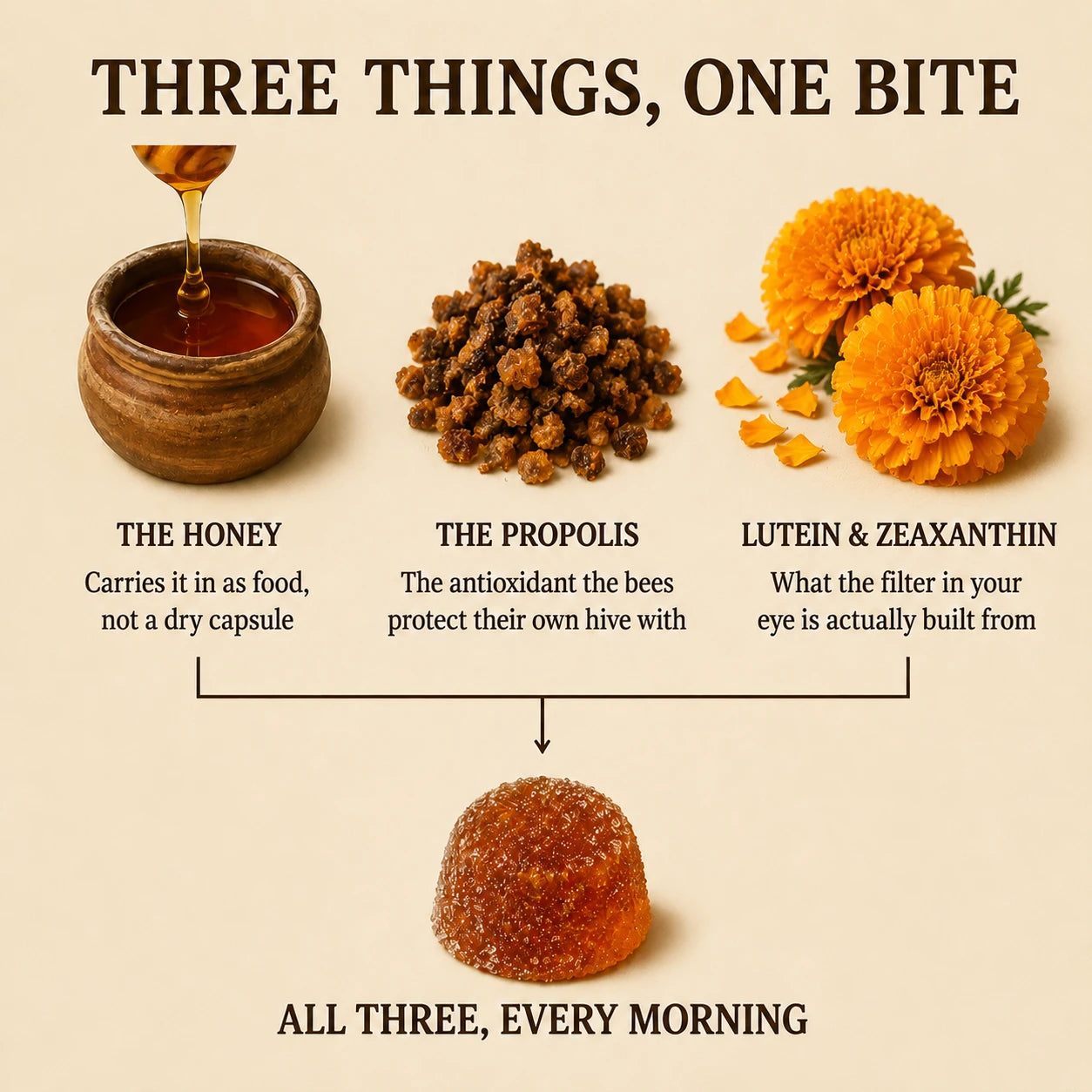
The same bees make propolis, which is the resin they line the hive with to protect everything inside it. When researchers finally tested it, it turned out to be one of the strongest natural antioxidants anybody has measured, and it comes off the exact same colonies those families have tended all along.
Which brings up the part Katie kept rereading.
Those families were right for three thousand years and had no idea why. Nobody in those kitchens knew what propolis was. Nobody had ever heard the word antioxidant. They just knew that this particular honey was the thing you gave to the children and the oldest people at the table, and they kept doing it, generation after generation, for longer than most countries have existed.
Then somebody finally put it under a microscope and found out they had been right all along.
Why the twelve-dollar bottle is a different thing entirely
There are three parts to it, and each one has a job.
The honey is the carrier. It's what turns this into food your body absorbs, instead of a dry capsule you have to remember to take with a meal.
The propolis is the antioxidant, the substance the bees line their own hive with to protect everything inside.
And the two nutrients are what the golden layer is actually built from. Those are the ones her body cannot make.
You need all three arriving together, in the same bite, every morning. That is what finally gives the glass something to lay back down clear.
Which is why the cheap bottle in the aisle is not the budget version of this. It is the one that is back in the drawer by the second week. And a jar of ordinary supermarket honey, however lovely on toast, was never carrying the two things the golden layer is built from.
An ancient hive full of antioxidants. A golden layer in the eye that has to be fed from outside. For three thousand years those two facts never once met in the same spoon.
The Pouch Her Daughter Left Without a Speech
Katie knew two things about her mother that no study could tell her.
Diane would never take "a pill for her eyes," because that would mean admitting the thing she had spent a year not admitting. And Diane abandons horse-pills by week two anyway. There is a junk drawer in Grand Rapids that proves it.
So Katie went looking for something that did not feel like medicine. What she found came from a small US brand called Lirosia, and it came with a story her mother, of all people, could not resist.
Real Jimerito honey, the little angel's honey, still rich in propolis from the same hives. And folded into it, the exact two nutrients the golden layer is made of, the pair her body cannot produce on its own. Put into the one format a proud, stubborn librarian would actually keep taking: two small amber-brown gummies that taste like what they are made with.

No speech. No "we need to talk about your eyes." A pouch left by the coffee maker, and two gummies that taste like honey.
Katie did not make a speech about it. She left the pouch on the counter beside the coffee maker with a sticky note.
"Two of these with your coffee, Mom. They taste like honey. Do it for me."
That is the quiet genius of the format, and why it works for stubborn people in particular. It doesn't ask them to admit anything. It is not eye drops. It is not a pill organizer with its little accusing days of the week. It is two amber-brown gummies that sit by the coffee and taste like honey.
And because a nurse who read all forty years of the research deserves the fine print out loud: it is made in a GMP-certified facility and third-party tested, so what the label says is what is in the gummy. The honey story is what got her mother to try it. The testing is why Katie could trust it.
When it shows up, and when it does not
Nothing happens overnight, and anyone who promises otherwise is selling you something. Glass that got pitted across twenty years does not clear in two weeks. It clears the way weather clears, and you notice it on one particular drive before you notice it anywhere else.
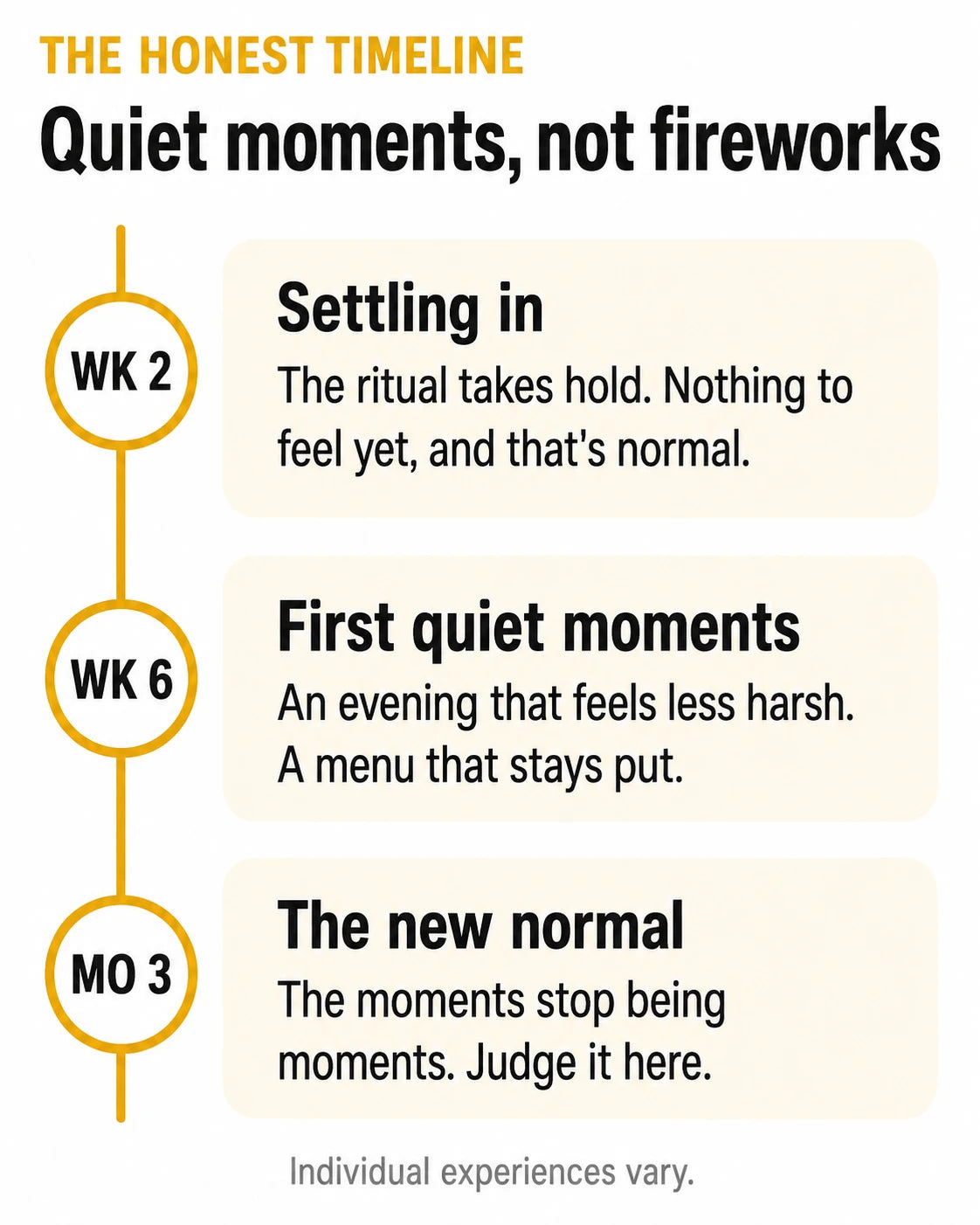
Diane did not argue about it. That, in the end, was the whole intervention. The first three weeks on the calendar had nothing in them.
The Twelve Weeks Diane Didn't Tell Anyone About
 BeforeAfter
Diane Kowalski, 68. Same car, same road home from Ruth's, five months apart. Individual experiences vary.
Diane did not keep a journal. She just noticed, the way you notice, because she had spent a year bracing.
Two gummies with the coffee. Diane reported one thing, and only one: "They taste like honey." Because that was all there was so far, and she was not about to hope on the strength of a flavor.
Nothing.
Diane nearly put the pouch in the junk drawer with the readers and the clip-ons. Most people quit right here. This is the week the whole thing is designed to survive.
She woke up on a Tuesday and the bedroom was just there. Sharp. No white second before it agreed to come back.
She lay still and waited for the haze the way you wait for a step that is not there. It did not come. She told nobody, in case it was a fluke.
Ruth came by on a Tuesday and found Diane at the kitchen table doing the crossword in pen, no magnifying sheet, working faster than she had in a year.
The stack of large-print books had migrated to the shelf by the door, on their way back to the library. Diane had not made a decision about them. She had just stopped reaching for them.
At Ruth's for dinner, Diane picked out Ruth's next-door neighbor across the living room and called her by name before the woman was halfway over. A small thing. Diane noticed it because for a year it had been the opposite of a small thing.
Then she stayed past dark, and drove herself home on the road she had been avoiding after sunset since spring. The oncoming headlights still bloomed. But the road stayed under her through the bloom, including the bend by the reservoir she had been taking at a crawl all year, and she never once let her speed sag down into the thirties the way she used to.
 BeforeAfter
The specials board. Same cafe, same doorway, twelve weeks apart. Individual experiences vary.
Sunday breakfast at the diner, the same dim booth. The specials were up on the board over the counter, the way they always are.
Diane read them out loud to Ruth. All of them. Off the board. Without the phone, without the little dance of holding the menu out and pulling it back.
Ruth went quiet. Then she said, "Diane. You just read that off the wall."
Diane had not even noticed she was doing it. That is what caught in her throat. Not the reading. The forgetting to brace.
That was five months ago. Diane has had two gummies with her coffee every morning since, including this one.
Twelve weeks. Five things back. No single day in that stretch was worth mentioning to anyone. A woman simply stopped handing her own life across the table to be read to her.
There is one sentence she keeps returning to when she talks about it.
"I spent thirty-one years putting the right book in the right hands. I had started to think I was quietly turning into a woman who couldn't read the specials. Turns out I was just a woman who ran out of something. I am still me. I just had to feed her back."
If the fog and the halos and the arm's-length print sound like your last few months, that is not an age problem and it is not a lamp problem. It's a supply problem.
And the supply is the one thing on that whole list you can actually do something about.
"The Headlights Were Just Headlights"
 BeforeAfter
Gordon T., 70. His own porch. Individual experiences vary.

"I'm an engineer by trade, so I went in skeptical and I kept notes, because that is what I do to a claim. Started mid-February, two with coffee, never missed a day. The note from April 30th says: drove home from the lake after sunset and realized at the county line I had not thought about the headlights once. That is the whole review. My wife read the notebook and said, 'you've been quiet about your eyes for months.' I had not told her because I did not believe it yet myself."

"For me it was church. Id started sitting near the front because the faces across the hall had gone soft and I never told a soul why. Around week eight I picked my own granddaughter out from the back row. My daughter thinks I just prefer the back pew now. Let her think it."

"Three capsule brands over the years and I quit every one by the second week. These I've stayed with since spring, mostly cause theyre the easiest part of my morning. Mornings sharpen up quicker and dusk is less harsh out on the porch. My son noticed Id stopped asking him to drive at night before I did."
Individual experiences vary.
Notice how small all three of those are. Nothing here arrives with a bang. Nobody is handed a miracle. They are handed back an ordinary week, one quiet thing at a time, and more often than not the person who says it out loud first is somebody else.
Picture a Night a Few Months From Now

"Ruth never said a word about it," Diane says. "But she stopped moving dinner up an hour for me. That is how I knew she had noticed too."
You drive home late from your sister's, and the headlights coming the other way are just headlights. Sharp, ordinary, a little boring. You had forgotten roads could feel boring. It is wonderful.
You walk into a crowded room that weekend and find the face you are looking for on the first try.
You read the specials board without the little dance of holding it out and pulling it back.
Nobody claps for any of it. But your daughter watches you hang the car keys back on the hook and says, "you seem like you again." You just nod.
Here is the last thing worth saying, and then I will leave it with you.
You know roughly how many good years you have left. Most people past sixty do. You have almost certainly done that sum once, quietly, and then never repeated it to anyone.
Nothing about that number changes today. What changes is how many of those years you spend leaving early, squinting at menus, and letting somebody else take the wheel after dark.
And this is the bit that slips past people. Giving yourself a few months to think about it is not a neutral choice. Those months are drawn from the same number. You would be paying for the decision with the thing the decision is about.
Diane lost a year to it before anybody told her what it was. She will tell you that is a year she would like back. She caught the rest of them in time.
— Marion Ellis

Optimal Vision Gummies
Real honey from a bee with no sting, carrying the two nutrients your body can't make.
- Lutein and zeaxanthin, the two nutrients the eye's golden layer is made of
- Real Jimerito honey, rich in propolis from the same hive
- Two amber-brown gummies with your morning coffee. That's the whole ritual.
- GMP-certified and third-party tested
References
- National Eye Institute (NIH): dietary lutein and zeaxanthin and the protective pigment at the center of the eye.
- Bone RA, Landrum JT, et al. Vision Research, 1985;25:1531-1535. Identification of the two dietary pigments at the center of the human eye.
- Hammond BR, et al. Investigative Ophthalmology & Visual Science, 2014. Randomised, double-blind, placebo-controlled, 1-year trial, 115 participants; pigment density, chromatic contrast and photostress recovery.
- Richer S, Novil S, Gullett T, et al. "Night Vision and Carotenoids (NVC)." Nutrients, 2021;13(9). Randomised placebo-controlled 6-month trial in older adults (mean age 62.7, n=33); glare recovery time and contrast sensitivity under glare.
- Systematic review and meta-analysis of lutein/zeaxanthin intake and pigment density, Advances in Nutrition, 2021 (46 studies, 3,189 participants).
- Centers for Disease Control and Prevention: vegetable intake among US adults (roughly 1 in 10 meets recommendations).
- AAA Foundation for Traffic Safety: glare, night-driving discomfort, and driving self-restriction among older adults.
- Published composition research on stingless-bee ("miel de angelita") honey: antioxidant and nutraceutical properties compared with ordinary honey.