I'm Your Eyes. I've Worked 60 Years Without a Day Off. And I'm Getting Tired.
Why the small print keeps getting blurrier after 50, and why it isn't your prescription. Plus the two-minute morning habit that's making stronger reading glasses pointless.
Your eyes are the only part of your body that has worked every waking second since the day you were born. There are two nutrients they're built to run on, and your body cannot make either one. They come from food you almost certainly stopped eating years ago.

All references are stated in the footer.

Frank Delgado, 67, handing the menu back. Retired mail carrier, thirty-one years on the same route in Tucson, the man neighbors still ask to fix things. Not the kind of person who quietly stops driving at night for no reason.
Frank Delgado handed the menu across the table and told his daughter he wasn't that hungry.
It was a Sunday. The restaurant was dim, the way the good ones are.
He had tilted the card toward the candle and the letters had gone soft at their edges, swimming a little, the way print does when you have stared at it too long. There was a dull ache building behind his right eyebrow from trying. He held it there a second longer than he wanted to, then handed it over.
He had read four thousand addresses a week in the rain for thirty-one years, and he could not read the word chicken from eighteen inches away.
So he lied about it.
He ordered what she ordered. He laughed in the right places. He drove home with the oncoming headlights blooming into starbursts and both hands on the wheel, and he didn't mention that either.
That's the part nobody warns you about. It doesn't hurt at all. It just makes you feel small in front of your own daughter.
"I wasn't scared of reading glasses," Frank says. "I was scared of the day my daughter decides she should drive."
Sitting in that booth, he wasn't the mail carrier who knew every faded house number in his part of Tucson. He was a man letting somebody else order his dinner.
Most of us know that feeling. And most of us do exactly what Frank did about it. Nothing.
That's because it never turns up all at once. It arrives one small adjustment at a time, and there's an excuse ready for every single one. You were tired. The lighting was bad. You're getting older.
But think about it for a second. Nobody has ever bought the brighter lamp, moved the menu further away, gone up a strength in reading glasses, and then gone back to reading the way they read at forty. Every one of those adjustments is a door that only opens one way.
But if your eyes could sit you down and write you a letter, it would read something like this:
"I'm your eyes. I've been on duty every waking second since the day you were born. I have never taken a day off.
When you hold the menu at arm's length, that's me, straining to reach you. When the headlights turn into stars, that's me, losing the light.
I'm not broken. I'm running low. There's something I need that your body has never once been able to make, and for years now, you haven't been sending enough of it.
You rest your back. You feed your heart. You take care of your knees. I'm the only one you forgot."
That letter isn't poetry. Every line of it tracks something real happening in the center of your eye.
Before we get to what that is, it's worth being honest about what it has already taken.
What It's Actually Costing You

Reading at arm's length at his own kitchen table. This is the part almost nobody reports to an optometrist, because it doesn't feel like an eye problem. It feels like a personal failure.
It starts small enough to explain away. A menu at arm's length. One more lamp.
Then it stops being about the print.
Ask a man what he's given up and he'll say nothing at all. Ask him what he does differently and the list runs long.
Frank used to read the paper out on the porch every morning. He stopped, because the light out there wasn't enough anymore, and he wasn't going to sit inside on a nice morning just to read a newspaper.
He stopped driving over to his brother's place after six in the evening. Then he stopped going on weeknights at all. He never gave a reason, and nobody asked him for one.

The wave that goes out first, every time, so nobody ever finds out.
At church he started waving first. Every single time. If you wave first, you never have to admit you couldn't tell who it was.
That's what this actually looks like. A life getting a little smaller every year, and every step of it explained away as something else.
So here is the honest version of the list. These aren't symptoms. These are the five things it takes from you, and they're in the order that matters.

Nobody says the number out loud. Most people over sixty have worked it out anyway.
If three or more of those sounded familiar, you're not imagining it and you're not being dramatic.
Frank had all five. He'd had all five for about four years.
And he had no idea that in about three months they were going to come back to him one at a time, in an order nobody would have predicted.
But first he did what everyone does. He went shopping.
I Tried Everything. It All Worked for About a Week.

Four years, six fixes, and a total he worked out on the back of an envelope. Every one of them a reasonable answer to the wrong question.
Before I tell you what finally worked for him, you need to see what didn't. I'm guessing your kitchen drawer looks a lot like his did, and I don't want you thinking any of it was a stupid thing to buy. I bought most of that list myself, for my own mother, before I knew what I know now.
Frank isn't a man who ignores a problem. He's a man who fixes things. Neighbors still knock on his door about their sprinklers. So he bought the fixes, in order. He added it up once on the back of an envelope, standing at that same kitchen window. Eight hundred and sixty-four dollars over four years, and nothing held.
The drugstore vitamins are the one he wants to be fair about. For about ten days he thought he felt something. It was enough to keep him buying them, but it was never enough to make him keep taking them.
Which is every line on that list, really. All of it helped for about a week.
And this is the part that makes people stop trying. The money is recoverable. The pattern is what wears you down.
Because every fix that fails moves you one step further along a road most people don't know they're walking.
Nobody Hands Over the Car Keys All at Once

Nobody announces it. It takes years, and almost everybody walks it one polite step at a time.
It isn't a diagnosis. It's a sequence, and it has four steps.
First you adjust. Stronger readers, brighter bulbs, the phone flashlight held over a menu.
Then you avoid. The night drives go first. Then the dim restaurant. Then the needle and thread, the crossword, the porch.
Then you ask. And one man in a published research interview said the quiet part out loud: "You can wear friends out real fast, asking for rides."
Then you depend. Waiting at a window for somebody to have time for you, in your own life.
Adjust. Avoid. Ask. Depend.
That is how it actually goes. Nobody hands the keys over all at once.
Read those four words again. Frank was standing on step two, and he had no idea there were another two waiting.

Twenty minutes in a hardware store parking lot with the engine off. He has never told anybody about this afternoon.
He did not drive straight home the afternoon he worked that out. He sat in the truck outside the hardware store for twenty minutes with the engine off, and he cried the way men his age cry when nobody ever taught them how to. It was not one dignified tear down the cheek. It was the ugly kind, with a hand clamped over his mouth so the sound stayed inside the cab, and his glasses off on the dash because they had fogged up.
He is sixty-seven. He has fixed every single thing anybody has ever carried up his driveway. He could not fix this one, and nobody had told him yet that it was even the kind of thing that could be fixed.
And here's the part that should bother you most, because it's the part nobody says out loud.
Frank has already spent four years on this. Not four years of being unable to see. Four years of reading for ten minutes instead of an hour, waving first at church so nobody would find out, and being home before the light went. He got those four years. He just didn't get to use them for very much.
That's the real price of it, and it doesn't come out of your wallet. It comes out of a number you already know.
Nobody is going to stop you, either.
Every visit checks how well you can see today, sells you a slightly stronger pair of glasses for today, and books you in again next year. It does that job well. It just never asks why you keep needing a stronger pair.
And this is the part that took Frank the longest to accept, so I'll say it the way he says it.
Nobody is hiding this from you. There's no cover-up and there's nobody being silenced. It's simpler than that, and honestly it's worse. There is nobody in that building whose job it is to tell you.
Your eye doctor gets paid to measure how well you see today and sell you the lens that fixes today. The pharmacy shelf gets paid when you come back for another bottle. The lab that makes the bottle gets paid the same whether it works or not. Follow the money all the way down that chain and you will not find one person who earns anything by telling you what actually ran out.
So they don't. Not out of malice. Out of arithmetic.
So Frank kept going back, kept getting a slightly stronger lens, and kept sliding.
Which left him with the question he finally asked out loud, in an exam chair, on a Tuesday afternoon.
If nothing I bought worked, then what is actually wrong with my eyes?
Then His Optometrist Turned the Lights Back On


Her name is Renata Ochoa. She'd been his optometrist for nine years, long enough that they had stopped being formal about it. Same office, same chair, same three minutes of small talk about the heat.
He asked the question. She didn't answer it.
She finished writing. Then she set the file down, which she never did before the end of an exam, and turned the room lights back up so she could see his face.
"Can I tell you something that isn't on your chart?"
He said yes.
"Your eyes aren't wearing out, Frank."
She said the next part slowly.
"They're running low on something."
That was the whole reveal. Nine years of appointments, and it took her turning the lights on to say it.
He asked why it had never come up before. She told him the truth, which is that it doesn't come up because there's nowhere on the form to put it.
The problem with your eyes isn't that they're wearing out. It's that they're running low.
Frank drove home and did what a man who fixes sprinklers does. He looked it up.
And he found the layer.
The Layer Nobody Talks About

The eye's own light filter. When it's well fed, light lands clean. When it runs low, light starts to scatter, and scatter is what you experience as glare and fading contrast.
There's a small patch at the back of your eye, right in the middle, where your sharpest vision happens. It's covered by a thin golden filter. Scientists have known about it for decades, and almost nobody outside an eye doctor's office has ever heard of it.
The easiest way to picture it is a pair of built-in sunglasses, worn on the inside, sitting exactly where you need to see best.
That filter is what lets you pick a face out across a room, read a menu in a dim restaurant, and see the road properly when headlights are coming the other way.
It's built out of two nutrients. They're called lutein and zeaxanthin, and they're the only things that filter is made of.
Now here's the part that changes how the last four years read.
Your body cannot make either one of them. Not a bit. Not at fifty, not at seventy, not in any amount, ever.
Every scrap of that filter came from something you ate. Mostly dark leafy greens, the kale and spinach and collards that most of us eat less and less of as the years go on.

A full plate is not the same as a fed eye. You can eat well every day and still take in almost none of the two things this filter is built from, because they come almost entirely from the dark greens most of us stopped eating years ago. Only about 1 in 10 American adults eats the recommended amount of vegetables, according to the CDC.
And this is where most people get it wrong, so let me be clear about it.
You are not underfed. You eat three meals a day. You probably eat more than you should. The problem is that almost nothing on a normal American plate carries these two, and the CDC says only about one in ten of us eats the vegetables we're supposed to. So the filter gets thinner. Not because of anything you decided. It gets thinner because nothing has been going back in.
Think about the tinted back window on a car that's sat in the Arizona sun for twenty years. It never cracks and it never peels. It just gets a little thinner every summer, until one evening the headlights behind you have turned into starbursts. And you cannot put that tint back by polishing the glass, because the tint isn't on the surface. It's in the glass.
A stronger prescription is a better piece of glass in front of your eye. It does nothing at all about the filter sitting behind it. Something inside your eye has been running out, and nobody has been putting it back.
Which raises the question Frank asked next. If this filter is real, why has nobody at the eye exam ever mentioned it?
The Part Your Eye Exam Doesn't Measure

Everything the visit measures can hold steady while the layer it never measures keeps thinning. That gap is where the glare, the fog, and the arm's-length menu live.
Frank did everything you're supposed to do. He went in for his exam every single year.
New prescription, pressure check, and the same sentence every time: "everything looks fine for your age."
There's a reason that answer never felt like enough.
A standard eye exam measures how well you can see today, with a lens held in front of you. That's all it was ever designed to do. There is no part of that appointment that checks whether the filter inside your eye is being fed, and there's no box on the form to write it in.
Your eye doctor isn't being careless and isn't hiding anything from you. It just isn't something they test for.
Which finally explains where the $864 went.
Every one of those fixes was aimed at the light going into his eye. Not one of them was aimed at the filter waiting inside it. Bigger print doesn't help when the light is already scattering before the words reach you, a better lens still sits in front of the thing that's thinning, and brighter bulbs throw more light at a filter whose whole job is absorbing it.
The capsules had the right idea in them. He just quit every bottle by week three, and eating a big salad on Sunday was one good day out of seven.
None of that was stupid and none of it was his fault. Every single one of those things was a sensible answer to the wrong question.
The right question turns out to be much simpler. What actually rebuilds that filter, and how do you get it in there every day without having to think about it?
The Golden Layer Method
There is no clever name for any of this, and I want to be straight with you about that.
The families who have been doing it for three thousand years never had a name for it. The researchers who eventually worked out why it works have never had any reason to give it one either. So I am going to call it the golden layer method, because that is literally what it is. You feed the golden layer. There is nothing else to it and nobody is selling you a system.

He wanted to know who says this and where. It took him one evening at his own kitchen table.
Frank is not a man who takes things on faith, so he went looking for who says this and where. He found three.
The National Eye Institute states it plainly: that filter is built from what you eat, and lutein and zeaxanthin are what it's made of. The CDC is where the one-in-ten number comes from. And the AAA Foundation for Traffic Safety has spent years documenting what older drivers actually do about glare, which is stop driving at night and then tell everybody it's the weather.
Three organisations, one story. The supply stopped, and people quietly rearranged their whole lives around it without ever knowing why.
Which brings up the thing Frank could not get past, and neither could I.
None of this is hidden. Two researchers worked out what that filter is made of in 1985. That is forty years ago. It is written on a government website you can read this afternoon, for free, in plain English.
And in nine years of appointments, in a room where somebody was measuring his eyes, nobody ever said one word of it to him.
That's not a secret anybody is keeping. That's a secret because there is nobody whose job it is to say it out loud.
So now Frank knew what had to go back in. What he didn't know yet is that putting it back is where almost everybody trips.
These two nutrients don't travel on their own. They only get absorbed properly when they arrive with some fat and some food around them. Swallow a dry capsule on an empty stomach and a good part of what you paid for goes straight through you.
So the capsules in his drawer had the right idea and nothing to carry it in, and a salad on Sunday was one good day out of seven. Neither of them was ever going to feed that layer.
And that is the point where his daughter found something that had all of it in one place.
What Frank's Daughter Found


Frank's daughter went looking the way everybody does now. Late at night, phone in hand, half expecting it to be nonsense.
She kept coming back to the same two nutrients. And then she found the bees.
The part nobody on that shelf can copy
There's a bee in Central America about the size of a grain of rice, and it has no sting at all. The families who keep them call it la angelita, which means "the little angel," and they have kept them the same way for roughly three thousand years.
A whole colony makes about one small jar of honey in a year. That's the entire yield. It's why you've never seen it in a shop, and why those families never sold it. It was too precious. They kept it at home and gave it out a spoonful at a time, mostly to the children and to the oldest people at the table.
Now here's the useful part. These bees line the inside of their hive with a substance called propolis. It's what they use to protect everything in there from damage. When researchers finally tested it, it turned out to be one of the strongest natural antioxidants anybody has measured.
So a gummy made from that hive does two jobs at once. It gives your eyes the two nutrients that filter is actually built from. And it carries them in real food, with the honey around them, instead of a dry capsule you have to remember to swallow with a meal.
And here is the part that stays with you once you have heard it.
Those families were right for three thousand years and had no idea why. Nobody in those kitchens knew what propolis was. Nobody had ever heard of an antioxidant. They just knew that this particular honey was the thing you gave to the children and the oldest people at the table, and they kept doing it, generation after generation, for longer than most countries have existed.
Then somebody finally put it under a microscope and found out they had been right the whole time.
Every other eye supplement on the shelf sells you the two nutrients in a pill. Not one of them can sell you the hive, because there isn't enough of it in the world to go around.
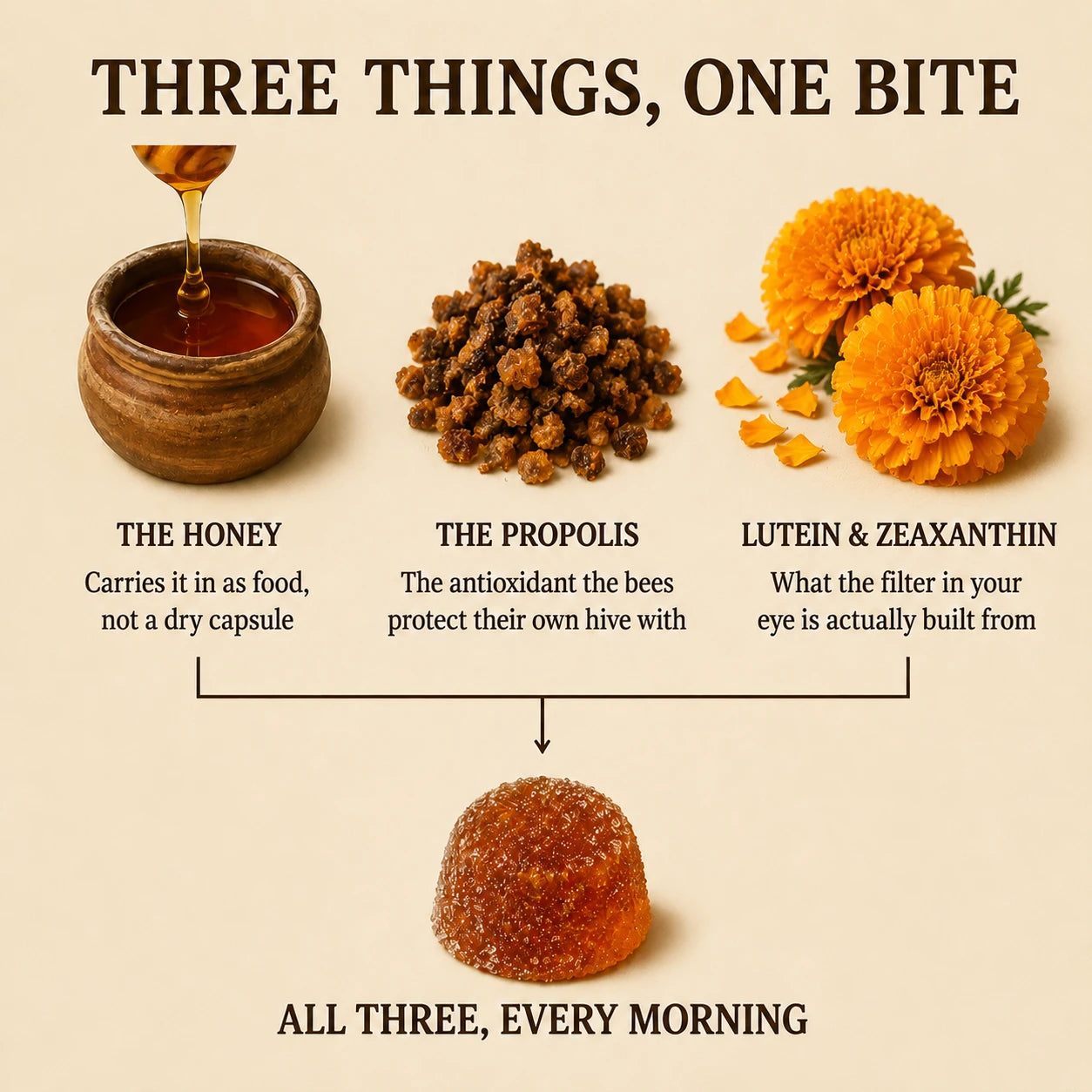
A small American company called Lirosia builds a daily gummy around that honey. Real Jimerito honey, rich in propolis, which is the protective substance those same bees line their hive with. And folded into it, the exact two nutrients that filter in your eye is made of. The two your body cannot make on its own, and has been running short of for twenty years.

There's no horse-pill to get down and no metallic aftertaste afterwards. It's two small amber-brown gummies with your morning coffee, and that filter gets fed today, tomorrow, and every day after that. Doing it every day is the whole trick, and it's the reason the capsules in the drawer never worked.
It's made in a GMP-certified facility and tested by an outside lab, so what the label says is what's actually in the gummy. And it comes from people who put a real honey at the middle of the story, instead of an actor in a lab coat.
What you should honestly expect, and when
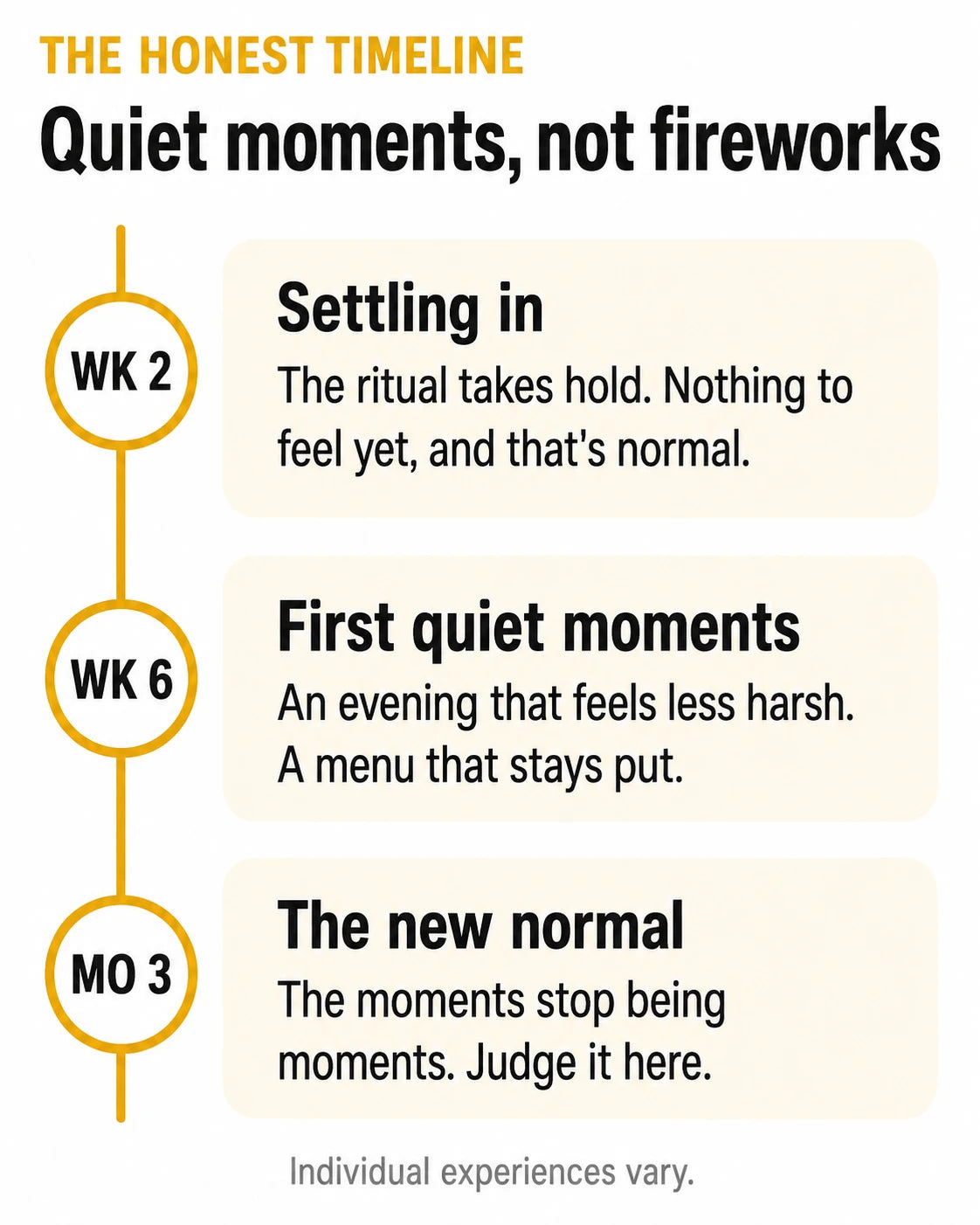
Twenty years of running low does not get fixed over a weekend, and anybody who tells you otherwise is selling you something. When things do come back, they come back the same way they left. Quietly, in small moments you only notice afterwards.
His daughter left the pouch next to the coffee maker and didn't say a word about it. She knew that a speech would have guaranteed he never touched it.
Frank's thinking wasn't complicated. He had already spent $864 on things that didn't work, so what was one more?
He started that Monday. Three weeks later, as far as anybody could tell, nothing whatsoever had happened.
What Happened Over the Next Ninety Days
 BeforeAfter
Frank Delgado, 67. Reading at his own kitchen table, four months apart. Individual experiences vary.
His daughter left him a notebook as well, which he thought was ridiculous, and then used anyway.
Two gummies with the coffee. They taste like honey, which he wrote down twice. Nothing else to report.
One line in the notebook that week: Nothing yet. Same as last week.
He very nearly stopped here, and most people do. This is the week that decides it.

Week 6. The porch, the paper, and a coffee that went cold while he was still reading it.
He took the newspaper out to the porch on a Saturday morning, out of habit more than hope, and read it. Not for ten minutes. He was still out there when his coffee went cold.
It was the smallest thing that had happened to him in four years, and he sat there for a while afterwards thinking about it.
He started a paperback on the Tuesday evening and read it in his chair, in the ordinary lamp light, the way he used to before any of this.
His eyes did not get tired after ten minutes. The words did not start to swim. He did not put it down and turn the television on instead. He looked up at some point because his hip had gone stiff, and it had been over an hour.
His brother mentioned a fishing trip in October that same week, and Frank said yes without doing the arithmetic first. He didn't work out what time it would get dark, or who else was going and could drive. He just said yes, the way he used to.
 BeforeAfter
Going out in the evening, before and after. Same porch, same time of night, ten weeks apart. Individual experiences vary.
He drove home from his brother's place after dark, on a weeknight, for the first time in three years. The headlights coming the other way were still bright, because headlights are bright. They just weren't starbursts anymore.
He didn't mention it to his daughter and she didn't mention it to him. But from that Sunday on, she stopped offering to drive.
At the church hall on the Sunday, a man waved at him from the far end of the room, and Frank said his name back before the man had finished turning around. He hadn't done that in years.
That evening, same dim restaurant, same booth. He read the specials off the board behind the counter and ordered the fish out loud, because he could see the word.
His daughter called midweek, and somewhere in the middle of the conversation she said, "you seem more like yourself lately."
He couldn't explain it to her and he still can't. All he knows is that he's had two gummies with his coffee every morning since, including this morning.
Ninety days, and he had them all back. Nothing dramatic happened on any single day of it. A man just started reading the paper on his own porch again, and driving home in the dark, and ordering his own dinner.
If your eyes have been quietly taking the evenings out, the books, the faces at church and your own dinner order, that is not a problem with your prescription. It's a problem with what's been running out.
"I Read the Whole Menu Out Loud"
 BeforeAfter
Arthur M., 71. His own workbench. Individual experiences vary.

"I've started and quit four different eye vitamins. Big capsules, and by week three they're in the drawer with the fish oil. These I've actually stayed with, because it's two gummies that taste like honey and there's nothing to talk myself into. Somewhere in month two I drove back from my brother's after dark and realized halfway home I wasn't white-knuckling it. I didn't tell my wife. She noticed anyway."

"Im seventy-two and I honestly thought whatever had gone was gone and this was money for a feeling. I keep them by the kettle so I don't forget. Week six or seven, dinner with the grandkids at a dim little Italian place, and I read the whole menu out loud including the specials. My daughter noticed before I said anything."

"Mine were never bad. Just tired by evening and a little worse every year, which is exactly why I did nothing about it for ten years. Evenings are easier now and I've stopped dragging the lamp around the living room. My husband asked what was different."
Individual experiences vary.
Notice how small all three of those stories are. That's not a coincidence, and it isn't us being modest. That is genuinely what this looks like when it works. Nobody gets a dramatic moment. They get an ordinary Tuesday that used to be harder than it is now.
Picture a Tuesday, About Three Months From Now

Frank at twelve weeks, reading the specials board from across the counter. His daughter had stopped offering to drive three weeks earlier.
There's nothing special about the day. You pick up a prescription and read the back of the box standing right there in the aisle, without reaching for the glasses hanging off your shirt.
You sit down with the paper after breakfast and you're still reading it when the coffee goes cold.
You say yes to something in the evening without first working out what time it gets dark.
You drive home afterwards, and the road just looks like the road.
And somewhere in a phone call that weekend, somebody who loves you says you seem more like yourself lately. You won't quite know how to explain it, so you probably won't try.
Here's the part worth sitting with for a second. You know roughly how many good years you have left. Most people over sixty do. You have probably worked it out once, late in the evening, and then never said the number out loud to anybody.
That number doesn't change today. What changes is how many of those years you spend leaving before dark, ordering whatever the person next to you ordered, and handing the map to the passenger seat.
And here's the part that's easy to miss. Deciding to think about it for a few months is not the same as doing nothing about it. Those months come out of the same number. You would be spending the exact thing you are trying to make a decision about.
Frank spent four of his working around it. He'd tell you that's four he'd like back.
— Marion Ellis

Optimal Vision Gummies
The two nutrients your body can't make, carried in real honey from a bee that has no sting.
- Lutein and zeaxanthin, the two things the filter in your eye is actually built from
- Real Jimerito honey, rich in propolis, the substance the bees line their hive with
- Two gummies with your morning coffee. That's the whole thing.
- Made in a GMP-certified facility and tested by an outside lab
References
- National Eye Institute (NIH): dietary lutein and zeaxanthin and the protective pigment at the center of the eye.
- Centers for Disease Control and Prevention: vegetable intake among US adults (roughly 1 in 10 meets recommendations).
- AAA Foundation for Traffic Safety: glare and night-driving avoidance among older drivers.
- Bone RA, Landrum JT, et al. Vision Research, 1985;25:1531-1535. Identification of the two dietary pigments at the center of the human eye.
- Hammond BR, et al. Investigative Ophthalmology & Visual Science, 2014. Randomised, double-blind, placebo-controlled, 1-year trial, 115 participants; pigment density, chromatic contrast and photostress recovery.
- Richer S, Novil S, Gullett T, et al. "Night Vision and Carotenoids (NVC)." Nutrients, 2021;13(9). Randomised placebo-controlled 6-month trial in older adults (mean age 62.7, n=33); glare recovery time and contrast sensitivity under glare.
- Systematic review and meta-analysis of lutein/zeaxanthin intake and pigment density, Advances in Nutrition, 2021 (46 studies, 3,189 participants).
- Peer-reviewed literature on presbyopia and age-related changes in visual comfort.
- Published qualitative interview research on older adults, glare, and driving cessation (source of the quoted interview line).